

What to Look for in a Payroll Provider for California and Multi-State Operations
Operating a business across state lines introduces a labyrinth of regulatory requirements that can quickly overwhelm even the most seasoned finance teams. California alone enforces over 1,500 pages of labor laws that dictate everything from overtime calculations to mandatory paid sick leave. When you add multi-state nexus rules into the mix, the risk of non-compliance penalties and tax errors multiplies exponentially. Choosing the right payroll partner is no longer just about processing checks; it is about securing your business against regulatory audits and operational bottlenecks. (Contact Us OnePoint HCM)
California-Specific Compliance Requirements
California is widely regarded as the most complex jurisdiction for payroll administration in the United States. The state has implemented aggressive labor protections that require precise tracking and reporting. A robust payroll provider must have native, up-to-date logic for these specific mandates rather than relying on generic national templates.
Wage and Hour Laws
One of the most critical aspects of California payroll is the strict adherence to wage and hour laws. This includes daily overtime calculations, which differ significantly from the federal standard. Daily overtime kicks in after eight hours of work, requiring employers to pay time-and-a-half for hours worked beyond that threshold. Furthermore, double time is required for any hours worked beyond twelve in a single day or beyond eight on the seventh consecutive day of work. A compliant system must automate these calculations in real-time to prevent costly underpayment liabilities.
Leave Management and ACA Compliance
California employers must also manage complex leave policies, including Paid Family Leave (PFL) and State Disability Insurance (SDI). These deductions require specific reporting codes and integration with state agencies. Additionally, businesses with five or more employees must comply with the Affordable Care Act (ACA) reporting requirements. ACA Manager tools within a payroll platform help automate the tracking of full-time equivalent employees and the issuance of necessary 1095-C forms. Without this integration, HR teams risk facing significant penalties for misreporting coverage data.
Emergency Contact and Data Privacy
Recent legislative updates have further complicated the landscape. For instance, the California Emergency Contact Law requires employers to allow employees to designate an emergency contact and specify notification preferences in the event of arrest or detention. Compliance updates like this demonstrate the need for a payroll provider that actively monitors and implements state-specific legislative changes. A static system that does not update its logic in response to new laws becomes an immediate liability.
Navigating Multi-State Tax Nexus
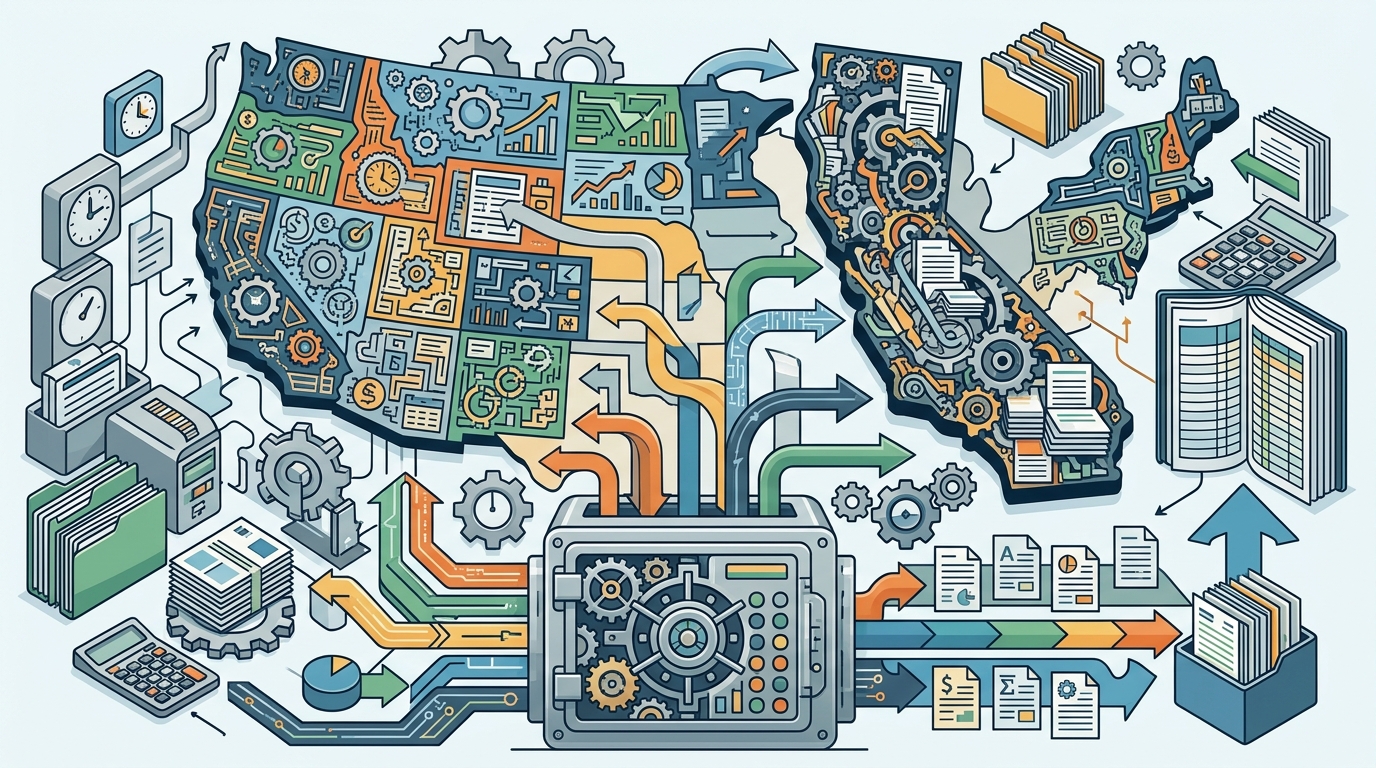
When your business operates in multiple states, you must establish a physical or economic presence, known as nexus, in each jurisdiction. This triggers obligations to register for state unemployment insurance, disability insurance, and income tax withholding. The complexity arises because each state has different registration thresholds, filing frequencies, and tax rates.
Dynamic Tax Rate Management
A reliable payroll provider must automatically detect changes in employee work locations and adjust tax withholdings accordingly. This is particularly challenging for remote workforces where employees may move across state lines. Dynamic tax engines update rates daily to reflect local municipal and county taxes that vary even within the same state. Manual updates are prone to error and often lag behind legislative changes, leading to under-withholding or over-withholding issues that require complex correction processes.
Unified Reporting and Filing
Managing filings across multiple jurisdictions requires a centralized reporting dashboard. The ideal platform consolidates all state-specific filings into a single workflow, reducing the administrative burden on your finance team. This includes quarterly unemployment tax reports, annual wage summaries, and monthly withholding returns. A unified system ensures that data consistency is maintained across all reports, preventing discrepancies that could trigger audits from multiple state agencies simultaneously.
Integration and Data Security
Payroll does not exist in a vacuum. It must seamlessly connect with your human resources information system (HRIS), time and attendance tracking tools, and accounting software. Fragmented data silos create inefficiencies and increase the risk of manual entry errors.
Seamless Data Flow
Look for a provider that offers robust integration capabilities with major platforms like Google Workspace, QuickBooks, and leading HR suites. Real-time synchronization ensures that time-off balances, salary changes, and new hire data flow automatically into payroll. This automation eliminates the need for duplicate data entry, allowing your team to focus on strategic initiatives rather than administrative cleanup.
Security and Compliance Standards
Payroll data contains sensitive personal information, including social security numbers and bank account details. Your provider must adhere to strict security standards, such as SOC 2 Type II compliance and encryption at rest and in transit. Additionally, the platform should offer granular user permissions to ensure that only authorized personnel can access or modify sensitive payroll data. Compliance frameworks like GDPR and CCPA must be supported to protect employee privacy rights, especially when operating in California.
Vendor Evaluation Checklist
Selecting the right payroll partner requires a structured evaluation process. Use the following criteria to assess potential vendors against your specific operational needs.
| Feature Category | Key Requirement | Why It Matters |
|---|---|---|
| California Compliance | Native PFL, SDI, and daily overtime logic | Prevents costly wage and hour violations |
| Multi-State Support | Automated nexus detection and tax filing | Ensures accurate withholding across jurisdictions |
| Integration | API access and pre-built connectors | Reduces manual data entry and errors |
| Support | Dedicated compliance experts and 24/7 helpdesk | Provides rapid resolution for complex issues |
| Reporting | Customizable dashboards and audit trails | Facilitates accurate financial forecasting |
Key Takeaways
- California Complexity: California labor laws are among the most stringent in the US, requiring specialized handling of overtime, leave, and tax deductions.
- Nexus Management: Multi-state operations require dynamic tracking of employee work locations to determine tax obligations accurately.
- Automation is Critical: Manual payroll processes cannot keep pace with the volume of regulatory changes across multiple jurisdictions.
- Integration Needs: Seamless data flow between HR, time tracking, and payroll systems is essential for data integrity and efficiency.
- Vendor Expertise: Choose a provider with a proven track record in handling complex compliance scenarios, such as those found in healthcare or manufacturing sectors.
- Security Standards: Ensure the platform meets SOC 2 and other relevant data protection standards to safeguard employee information.
- Scalability: Your payroll provider must be able to scale with your business, supporting growth into new states without significant operational disruption.
Frequently Asked Questions
What is the most challenging aspect of California payroll compliance?
The most challenging aspect is managing the intersection of daily overtime rules, mandatory paid leave accruals, and complex tax withholdings. These requirements often conflict with federal standards, necessitating a specialized system.
How does multi-state nexus affect payroll tax withholding?
Nexus determines where your business has a tax obligation. When an employee works in a state where you have nexus, you must withhold income tax and pay unemployment insurance for that state, even if your headquarters is elsewhere.
Can a single payroll provider handle all 50 states?
Yes, leading providers like ONEHCM offer comprehensive multi-state support. However, it is crucial to verify that they have specific expertise in the high-compliance states relevant to your business, such as California and New York.
What is the role of ACA compliance in payroll?
ACA compliance requires tracking full-time equivalent employees and reporting health coverage information. Payroll systems must integrate with benefits administration tools to ensure accurate data reporting to the IRS and state agencies.
How often do payroll tax rates change?
Payroll tax rates can change annually or even quarterly, depending on the state and local jurisdiction. A reliable provider updates these rates automatically to ensure continuous compliance.
What integrations are essential for multi-state payroll?
Essential integrations include time and attendance systems for accurate hour tracking, HRIS for employee data management, and accounting software for financial reporting. API access allows for custom integrations tailored to your tech stack.
How can I ensure data security for payroll information?
Look for providers with SOC 2 Type II certification, end-to-end encryption, and regular third-party security audits. Additionally, ensure they have clear data privacy policies that comply with regulations like CCPA.
Next Steps for Streamlined Payroll
Navigating the complexities of California and multi-state payroll requires more than just software; it requires a dedicated partner who understands the nuances of labor law and tax compliance. ONEHCM offers a unified platform that consolidates HR, payroll, and benefits administration into a single system. Our dedicated support team works with you to tailor the solution to your specific operational needs, ensuring seamless compliance and efficiency. Request a demo today to see how ONEHCM can transform your payroll processes and support your business growth.