

Essential Payroll and Time Tracking Features for California Small Business Compliance
California employers face some of the most stringent labor regulations in the United States, making accurate payroll and time tracking non-negotiable for operational survival. Recent legislative updates have intensified scrutiny on wage and hour compliance, with penalties for non-compliance reaching six figures for even minor infractions. According to the California Department of Industrial Relations, the state enforces rigorous standards that require precise documentation of every hour worked, overtime calculated correctly, and mandatory meal and rest periods strictly adhered to. This guide outlines the critical features your small business must implement to navigate this complex landscape while leveraging modern Human Connection Management (HCM) principles to protect your workforce. (Contact Us OnePoint HCM)
Real-Time Time Tracking and Geofencing
The foundation of California compliance is the accurate capture of time. Traditional spreadsheets fail to capture the nuance of on-the-clock versus off-the-clock work, leading to significant legal risks. Modern HCM platforms must offer robust timekeeping solutions that allow employees to clock in and out from any device, ensuring data integrity regardless of location.
Mobile Accessibility and GPS Verification
For small businesses with field teams, mobile accessibility is critical. Employees must be able to record their time via a dedicated app, which reduces administrative burden and prevents lost time cards. According to the U.S. Bureau of Labor Statistics, the majority of modern workforces utilize mobile devices for daily tasks, making a mobile-first timekeeping solution a standard requirement rather than a luxury.
Geofencing for Accuracy
To prevent buddy punching and ensure employees are at the correct job site, geofencing technology restricts clock-ins to specific geographic boundaries. This feature provides an audit trail that proves where work was performed, a crucial detail during labor audits. ONEHCM supports advanced time clock capabilities that integrate seamlessly with this verification process, ensuring that every hour billed is legitimate and defensible.
Complex Overtime Calculation Engines
California overtime rules are among the most complex in the nation. Unlike federal law, which generally requires overtime after 40 hours in a workweek, California mandates overtime after 8 hours in a workday and after 12 hours for double time. Additionally, overtime is required on the seventh consecutive day of work.
Automated Daily vs. Weekly Calculations
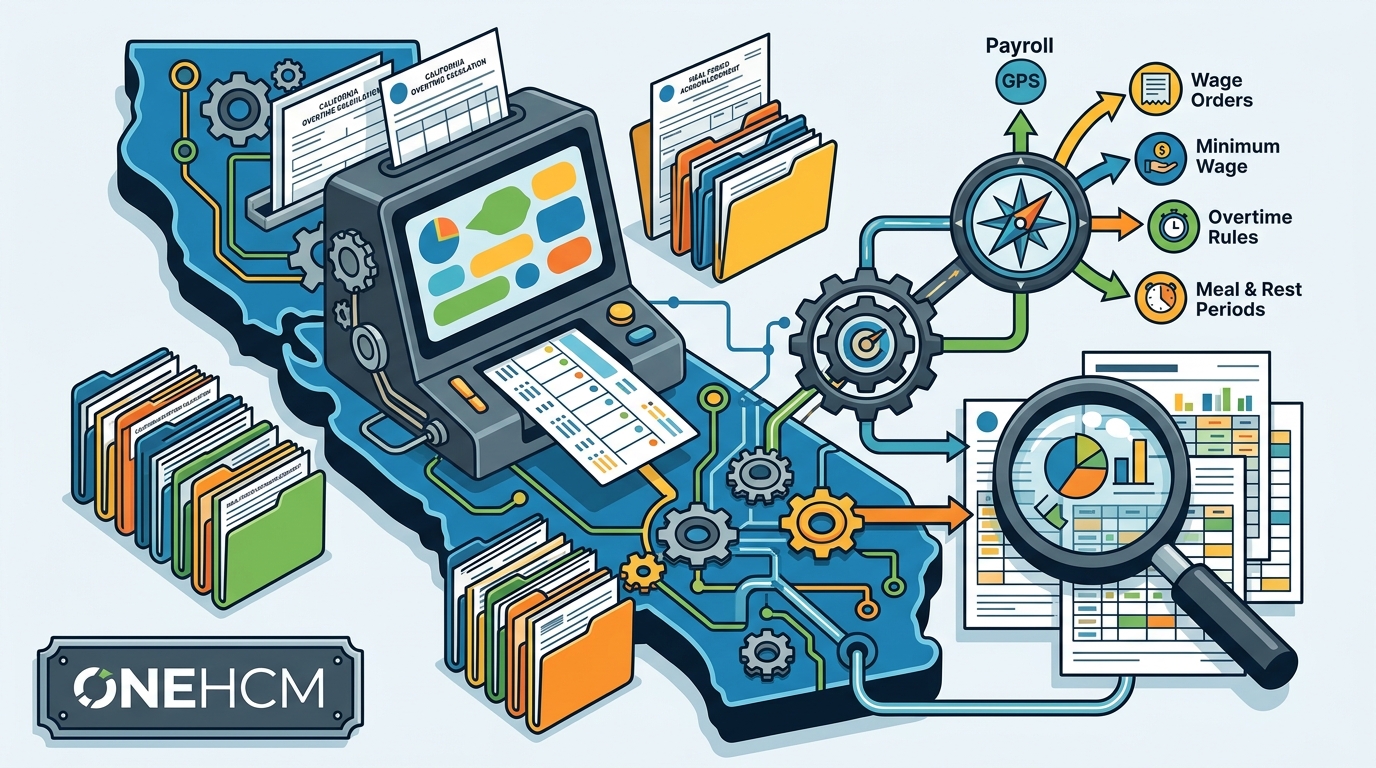
A compliant payroll system must automatically calculate both daily and weekly overtime. Manual calculations are prone to error, and the cost of correcting underpaid wages is high. The system must recognize the specific pay period structure and apply the correct multiplier (1.5x or 2x) based on the exact hours worked within that day.
Double Time and Seventh Day Rules
Double time must be automatically triggered after 12 hours in a single day. Furthermore, if an employee works seven consecutive days, the first eight hours of the seventh day are paid at 1.5x, and any hours beyond that are paid at 2x. A sophisticated payroll engine handles these calculations in real-time, preventing costly miscalculations that can lead to wage theft claims.
Automated Meal and Rest Period Enforcement
One of the most common sources of litigation in California is the failure to provide mandatory meal and rest breaks. Labor Code Section 512 requires a 30-minute unpaid meal break for every five hours worked, and a 10-minute paid rest break for every four hours worked.
Real-Time Alerts and Deductions
Compliance requires more than just policy; it requires enforcement. The best time tracking features include real-time alerts that notify managers when an employee has exceeded their break window. This proactive approach allows for immediate correction, reducing the risk of "meal period premium" penalties, which are essentially one hour of pay for each missed break.
Documentation for Audits
When a labor audit occurs, documentation is your primary defense. A unified system that records not just clock-in and clock-out times, but also break start and end times, provides the necessary evidence to prove compliance. This level of detail is essential for demonstrating good faith efforts to adhere to state regulations.
Prevailing Wage and Certified Payroll
For small businesses operating in construction or manufacturing sectors, prevailing wage laws add another layer of complexity. Prevailing wage laws require contractors on government-funded projects to pay workers region-specific rates, while certified payroll is the weekly reporting that proves compliance.
Automated Certified Payroll Reporting
Generating certified payroll reports manually is error-prone and time-consuming. A compliant HCM system should automate the generation of these reports, ensuring that all required fields are populated correctly and that fringe benefits are calculated accurately. This automation reduces the administrative burden significantly, allowing HR teams to focus on strategic initiatives rather than data entry.
Integration with Government Portals
Many jurisdictions require direct submission of certified payroll data to government portals. Integration capabilities allow your payroll data to flow directly into these systems, reducing the risk of submission errors and ensuring timely compliance. This seamless flow of data is a hallmark of modern, integrated HCM solutions.
Seamless Integration Ecosystems
Disparate systems create data silos that hinder compliance and efficiency. An integrated approach ensures that time data flows directly into payroll, benefits, and accounting systems without manual intervention. This reduces the risk of errors and ensures that all departments are working with the same, up-to-date information.
Unified Employee Record
ONEHCM emphasizes the concept of a "One Employee Record," which means that data entered once is accessible across all modules. This unified approach ensures that payroll, benefits, and time tracking are always aligned, providing a single source of truth for all employee data.
Third-Party App Connectivity
Small businesses often rely on a stack of specialized tools. A robust integration directory allows your HCM platform to connect with these tools, whether they are for accounting, recruiting, or benefits administration. This connectivity ensures that your technology stack works together to support your business goals.
Key Takeaways
- California Overtime Complexity: Overtime is calculated daily, not just weekly, requiring 1.5x pay after 8 hours and 2x pay after 12 hours in a single day.
- Meal Break Penalties: Failure to provide a meal break results in a "premium pay" penalty of one hour of regular pay for each day the break is missed.
- Prevailing Wage Requirements: Government-funded projects require specific wage rates and weekly certified payroll reporting, which must be automated to avoid errors.
- Mobile Timekeeping: Field employees must be able to clock in/out via mobile devices with geofencing to ensure accurate location-based time tracking.
- Unified Data: A single employee record across HR, payroll, and time tracking eliminates data silos and reduces compliance risks.
- Real-Time Alerts: Automated alerts for missed breaks and overtime thresholds allow for immediate correction before penalties accrue.
- Integration Capabilities: Seamless connections with accounting and benefits systems ensure data integrity and reduce administrative overhead.
Frequently Asked Questions
How does California calculate overtime for non-exempt employees?
California calculates overtime based on both daily and weekly hours. Non-exempt employees are entitled to 1.5 times their regular rate of pay for all hours worked over 8 in a workday and over 40 in a workweek. They are also entitled to double time for hours worked over 12 in a workday and over 8 on the seventh consecutive day of work.
What is the penalty for not providing meal breaks in California?
If an employer fails to provide a required meal break, they must pay the employee one additional hour of pay at the employee's regular rate of compensation for each workday that the meal period is not provided. This is known as a "meal period premium."
Do small businesses in California need to track off-the-clock work?
Yes. Employers are responsible for paying for all hours worked, including off-the-clock work. If an employer knows or should have known that an employee was working, they must pay for that time. Accurate time tracking is essential to identify and compensate for any off-the-clock work.
What is certified payroll and who needs to file it?
Certified payroll is a report that details the wages paid to workers on public works projects. Contractors and subcontractors working on government-funded construction projects in California are required to file certified payroll weekly to prove they are paying prevailing wages.
How can I ensure my time tracking system is compliant?
Ensure your system automatically calculates daily and weekly overtime, tracks meal and rest breaks, supports mobile timekeeping with geofencing, and generates certified payroll reports if applicable. Regular audits of your system's output against California labor laws are also recommended.
Is mobile timekeeping legal in California?
Yes, mobile timekeeping is legal and widely used in California, provided that the system accurately records the time and location of work. Employers must ensure that employees are not required to work off-the-clock while using the mobile device.
What is the "One Employee Record" concept?
The "One Employee Record" concept refers to a unified data architecture where all employee information, including HR, payroll, time, and benefits, is stored and managed in a single system. This eliminates data silos and ensures consistency across all business processes.
How does ONEHCM help with California compliance?
ONEHCM provides an all-in-one platform that automates complex payroll calculations, tracks time accurately with mobile and geofencing features, manages benefits administration, and ensures compliance with California labor laws through real-time data and reporting.
Next Steps for Compliance
Navigating California's labor laws requires more than just good intentions; it requires the right tools and expertise. ONEHCM offers a comprehensive Human Connection Management platform designed to simplify compliance while enhancing employee engagement. By consolidating your HR, payroll, and time tracking into a single, unified system, you can reduce risk and focus on what matters most: your people.
Ready to streamline your compliance efforts? Request a Demo today to see how ONEHCM can transform your workforce management. For more insights on HR best practices, explore our Blog or review our Integration Directory to see how ONEHCM connects with your existing tools.