

Choosing a Multi-State Payroll Provider: California Compliance and Beyond
This article is general information, not legal advice. Wage and hour, scheduling, and privacy obligations depend on your industry, headcount, and specific work locations. Consult employment counsel before making payroll or policy decisions.
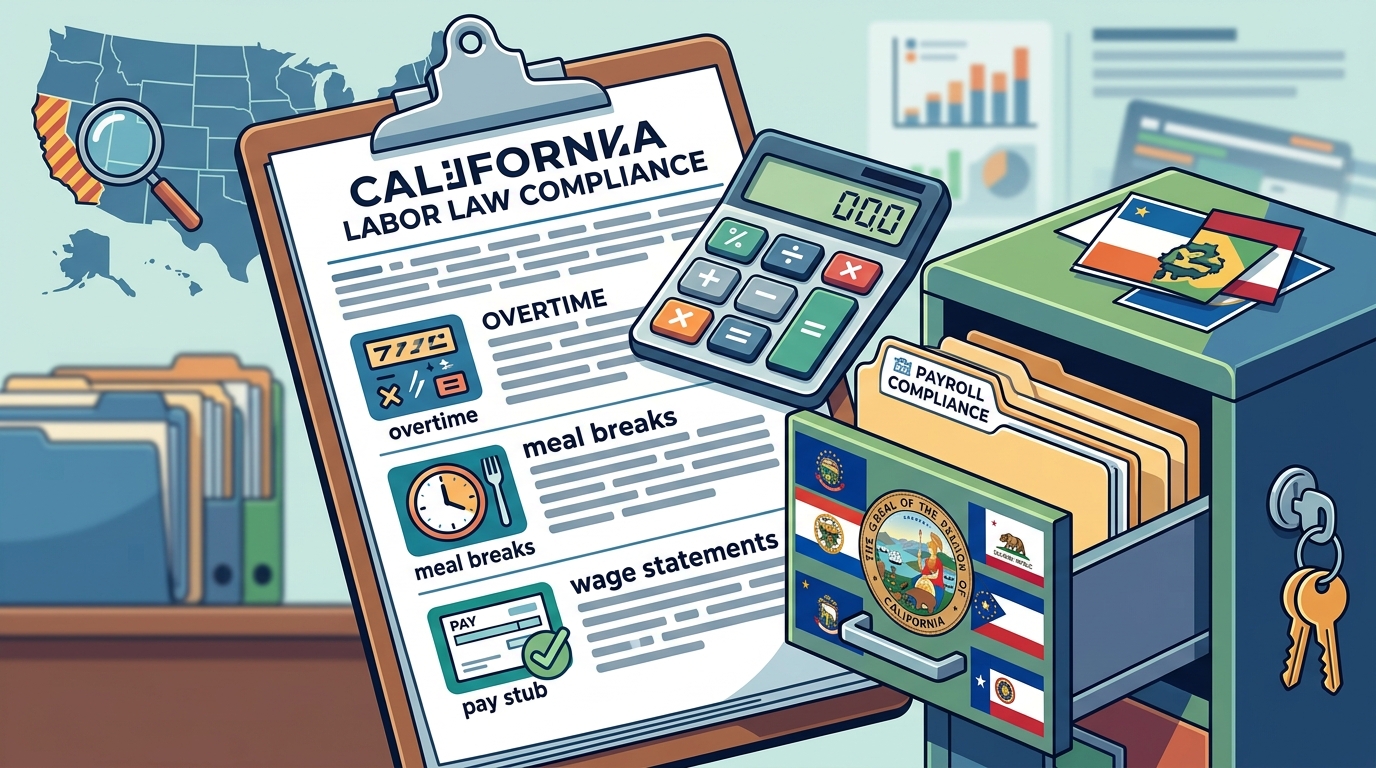
Operating across state lines means managing overlapping and sometimes conflicting regulatory regimes. California payroll compliance is widely regarded as the most demanding in the country: overtime accrues on a daily basis rather than only weekly, wage statements must contain nine specific data elements under Labor Code §226(a), and several California cities impose scheduling ordinances with no statewide equivalent. Add a second or third state and the surface area for error grows faster than headcount does. This guide covers what California actually requires and what to demand from a multi-state provider.
Understanding the Complexity of California Payroll
California is not just another state on the map for payroll providers. Its Labor Code is extensive and, in several areas, structurally different from federal law rather than merely stricter. For businesses expanding into California, this is not a matter of turning up a dial — it means the underlying calculation logic has to change.
Overtime: A Different Structure, Not Just a Lower Threshold
Federal law under the FLSA requires overtime only after 40 hours in a workweek. California Labor Code §510 layers a daily standard on top:
- 1.5x the regular rate for hours over eight in a workday, over 40 in a workweek, and for the first eight hours on the seventh consecutive day of work in a workweek.
- 2x the regular rate for hours over 12 in a workday, and for hours beyond eight on the seventh consecutive day of work in a workweek.
A system that only aggregates weekly hours will silently underpay California employees — someone working four 10-hour days owes eight hours of daily overtime despite never crossing 40. Any provider you evaluate must compute daily thresholds natively.
Wage Statement Requirements
Labor Code §226(a) requires itemized wage statements containing nine specific elements: gross wages earned; total hours worked (for non-exempt employees); the number of piece-rate units and applicable piece rate, if applicable; all deductions; net wages earned; the inclusive dates of the pay period; the employee's name and the last four digits of their SSN or an employee ID number; the name and address of the legal entity that is the employer; and all applicable hourly rates in effect during the pay period with the corresponding hours worked at each rate. Employers paying piece rate must also meet the additional itemization in §226.2(a)(2).
Penalties are not automatic on any error. Under §226(e), an employee suffering injury from a knowing and intentional failure may recover the greater of actual damages or $50 for the initial violation and $100 per employee for each subsequent pay period, capped at $4,000, plus costs and reasonable attorney's fees. The cap is per employee — which is why these claims are typically brought as class or PAGA actions, and why the aggregate exposure is what matters.
Scheduling Ordinances: City-Level, Not Statewide
California has no statewide predictive scheduling law. Obligations exist at the city level, and each ordinance has its own coverage thresholds and industries:
- San Francisco — Formula Retail Employee Rights Ordinances, covering formula retail chains, with predictability pay for short-notice changes.
- Los Angeles — Fair Work Week Ordinance, effective April 1, 2023, covering retail employers with 300 or more employees globally; 14 days' advance notice, good-faith schedule estimates, and a 10-hour rest requirement between shifts. Los Angeles County adopted a separate ordinance for unincorporated areas.
- Emeryville — covering retail and fast food employers meeting global and local headcount thresholds; two weeks' advance notice.
- Berkeley — covering employers with 10 or more employees in the city across designated industries, subject to global headcount thresholds.
- San Jose — narrower; primarily requires offering additional hours to existing part-time employees before hiring.
Outside California, comparable ordinances exist in Seattle, New York City, Chicago, Philadelphia, and Washington D.C., and Oregon has a statewide law. The thresholds, notice periods, and predictability pay rules differ in each. For a multi-state employer, this is the clearest case for scheduling that is location-aware rather than uniform. (Verify current coverage against each city's ordinance — thresholds have been amended repeatedly.)
Workplace Know Your Rights Act (SB 294 / Labor Code §1555)
Effective January 1, 2026, this law created two obligations. Employers had to distribute the Labor Commissioner's Know Your Rights notice to all employees by February 1, 2026, and must continue providing it to new hires and annually thereafter. Separately, by March 30, 2026, employers had to give employees the opportunity to designate an emergency contact and elect whether that contact is notified if the employee is arrested or detained — at the worksite, or offsite during work hours where the employer has actual knowledge. New hires must be offered the same at hire, and employees must be able to update the designation at any time.
A generic emergency contact form does not satisfy this; the form must explicitly address arrest and detention notification. Penalties reach $500 per employee per violation, up to $10,000 per employee for continuing violations. Both deadlines have passed, so this is current exposure rather than an upcoming change.
Key Features for Multi-State Operations
When your business operates in multiple states, your payroll provider becomes the central hub for workforce data. Managing diverse regulatory environments from a single interface is the main differentiator between adequate and exceptional payroll software.
Unified Employee Record
A One Employee Record architecture matters most at the moments data changes hands: an employee relocating, splitting time across states, or moving between exempt and non-exempt status. A single centralized profile holding tax withholdings, benefits enrollments, and work locations means a change of work state updates tax jurisdiction and applicable rules together, rather than in three systems on three timelines.
Automated Tax Filing and Payments
Multi-state payroll spans federal, state, and local jurisdictions — and local matters more than employers expect, with municipal income taxes in Ohio and Pennsylvania, and varying reciprocity agreements between states. Automated filing and payment services handle calculations, forms, and deposits per jurisdiction, which is where late-fee exposure concentrates.
Real-Time Data and Reporting
Customizable dashboards tracking payroll costs, tax liabilities, and compliance metrics across states support budgeting and forecasting where rates and labor costs vary. More practically: they let you catch a misconfigured jurisdiction before it becomes four quarters of amended returns.
How to Evaluate a Provider
Rather than assume what any category of vendor does or doesn't do, use these as demo requirements. Ask each provider to show them working — not to confirm they exist.
| Capability | What to ask the provider to demonstrate | Why it matters |
|---|---|---|
| Daily overtime | Run a four-day, 10-hour-per-day week and show the OT calculation | Weekly-only aggregation underpays California employees at 40 hours flat |
| Wage statement compliance | Produce a live stub and walk all nine §226(a) elements | Missing elements drive class and PAGA claims |
| Location-aware scheduling | Show different advance-notice rules applying to two cities in one org | Scheduling ordinances are city-level with different thresholds |
| Multi-state tax filing | Show a mid-year employee relocation and the resulting jurisdiction change | Relocation is where withholding errors originate |
| Employee privacy requests | Show how an employee DSAR is fulfilled within 45 days | CCPA applies to employee data as of January 1, 2023 |
| Emergency contact election | Show the arrest/detention yes-no election and its audit trail | A generic contact form does not satisfy Labor Code §1555 |
| Support model | Name who you call, their hours, and their California expertise | Complex jurisdictions surface questions no help article answers |
Integration and Data Security Considerations
Handling employee data across jurisdictions raises both security and privacy obligations, and they are not the same thing.
Security Standards
Ask whether a provider holds a current SOC 2 Type II report and request it under NDA. Worth knowing: SOC 2 is an attestation report issued by an independent auditor, not a certification — the meaningful questions are which Trust Services Criteria were in scope, whether it's Type I (design at a point in time) or Type II (operating effectiveness over a period), and whether any exceptions were noted. "SOC 2 compliant" on a website tells you little on its own.
Employee Data Privacy Under CCPA
This is the area most payroll content gets wrong. The CCPA's exemption for HR and employee data expired on January 1, 2023, when the CPRA took full effect and the legislature declined to extend it. Employees, job applicants, contractors, officers, and directors of covered businesses now have the full set of CCPA rights over their personal information — access, deletion, correction, and opt-out — not merely the right to a collection notice.
Practically, that means covered employers must include employee data in privacy policy disclosures, be able to respond to an employee data subject access request within the 45-day statutory window, and have data processing agreements with vendors that touch employee personal information. Your payroll provider is one of those vendors. Coverage thresholds apply — generally businesses with over $25 million in annual gross revenue, or meeting the data-volume or data-sales criteria — so confirm whether you are a covered business.
Integrations
Robust integration with your existing HR, accounting, and time-tracking stack reduces manual re-entry, which is where errors originate. Map your actual integration requirements before demos rather than accepting a generic connector list.
Vendor Support and Service Commitment
The best payroll software is useless if you cannot get help when you need it. In complex regulatory environments, access to people who know the jurisdiction is worth more than another dashboard.
Proactive Compliance Updates
California legislation changes constantly — SB 294 and AB 889 both landed with January 1, 2026 effective dates. A good provider updates their software ahead of effective dates rather than after, and tells you what changed and what you need to do about it. OnePoint HCM maintains an ongoing compliance blog covering California regulatory developments.
Personalized Service
Every business has different needs. Look for a provider offering dedicated account management, custom reporting, and tailored onboarding — and ask concretely who you would be calling and what their response commitment is.
OnePoint Human Capital Management (OnePoint HCM) unifies HR, payroll, and time & labor management on a single platform, which removes the hand-offs between systems where compliance gaps form. (OnePoint HCM platform overview)
Key Takeaways
- California overtime is structurally different: §510 requires 1.5x after eight hours in a day and 2x after 12, plus seventh-consecutive-day rules — weekly-only logic will underpay.
- Wage statements need nine specific elements under §226(a); penalties under §226(e) require a knowing and intentional failure plus injury, capped at $4,000 per employee, plus fees.
- There is no statewide California predictive scheduling law. Obligations are city-level — San Francisco, Los Angeles, Emeryville, Berkeley, San Jose — with different thresholds and industries.
- SB 294 deadlines have passed: Know Your Rights notice was due February 1, 2026 and emergency contact designation by March 30, 2026, with penalties up to $10,000 per employee.
- CCPA applies to employee data since January 1, 2023 — covered employers must handle employee DSARs within 45 days.
- A unified employee record matters most at relocation and status changes, where multi-system drift creates withholding errors.
- Evaluate by demonstration, not by feature list — ask providers to run the edge cases live.
Frequently Asked Questions
How is California overtime different from federal overtime?
Federal law requires overtime only after 40 hours in a workweek. California Labor Code §510 adds a daily standard: 1.5x after eight hours in a workday and after 40 in a week, 2x after 12 hours in a workday, plus 1.5x for the first eight hours and 2x beyond eight hours on the seventh consecutive day of work in a workweek.
What must a California wage statement include?
Labor Code §226(a) requires nine elements: gross wages earned; total hours worked for non-exempt employees; piece-rate units and rate if applicable; all deductions; net wages earned; inclusive dates of the pay period; employee name and last four of SSN or employee ID; the name and address of the legal entity that is the employer; and all applicable hourly rates in effect with corresponding hours worked at each. Piece-rate employers must also meet §226.2(a)(2) itemization.
Does California have a statewide predictive scheduling law?
No. California has no statewide predictive scheduling law. Requirements exist at the city level — including San Francisco, Los Angeles, Emeryville, Berkeley, and San Jose — each with its own covered industries, headcount thresholds, notice periods, and predictability pay rules. Employers with locations in multiple California cities may be subject to different rules in each.
Does the CCPA apply to employee data?
Yes, as of January 1, 2023. The CCPA's HR data exemption expired when the CPRA took full effect. Employees, applicants, and contractors of covered businesses now have full CCPA rights over their personal information, including access, deletion, and correction, and employers must respond to requests within 45 days.
What is the most challenging aspect of California payroll compliance?
Typically the interaction between rules rather than any single rule. Daily overtime, the regular rate calculation, meal and rest premiums, and nine-element wage statements all depend on each other — an error in one propagates. The wage statement is where the others become visible and actionable in litigation.
How does a unified employee record help multi-state businesses?
It centralizes employee data so that a change — most commonly a relocation or work-state split — updates tax jurisdiction and applicable rules in one place rather than requiring parallel updates across systems that can drift apart.
How can I evaluate whether a payroll provider is secure?
Ask for the current SOC 2 report under NDA and check whether it is Type I or Type II, which Trust Services Criteria were in scope, and whether exceptions were noted. SOC 2 is an auditor's attestation, not a certification, so the report's contents matter more than the label. Also confirm encryption, access controls, and whether the provider will sign a data processing agreement covering employee personal information.
How does OnePoint HCM help with compliance?
OnePoint HCM unifies HR, payroll, and time & labor management in a single platform with a shared employee record, reducing the system hand-offs where compliance gaps form, and maintains ongoing compliance resources covering California regulatory changes.
Next Steps for Your Business
Multi-state payroll and California compliance are demanding, but they are tractable with the right systems and the right partner. OnePoint HCM offers a Human Capital Management platform unifying HR, payroll, and compliance tooling. Request a demo to see how it handles your specific jurisdictions.