

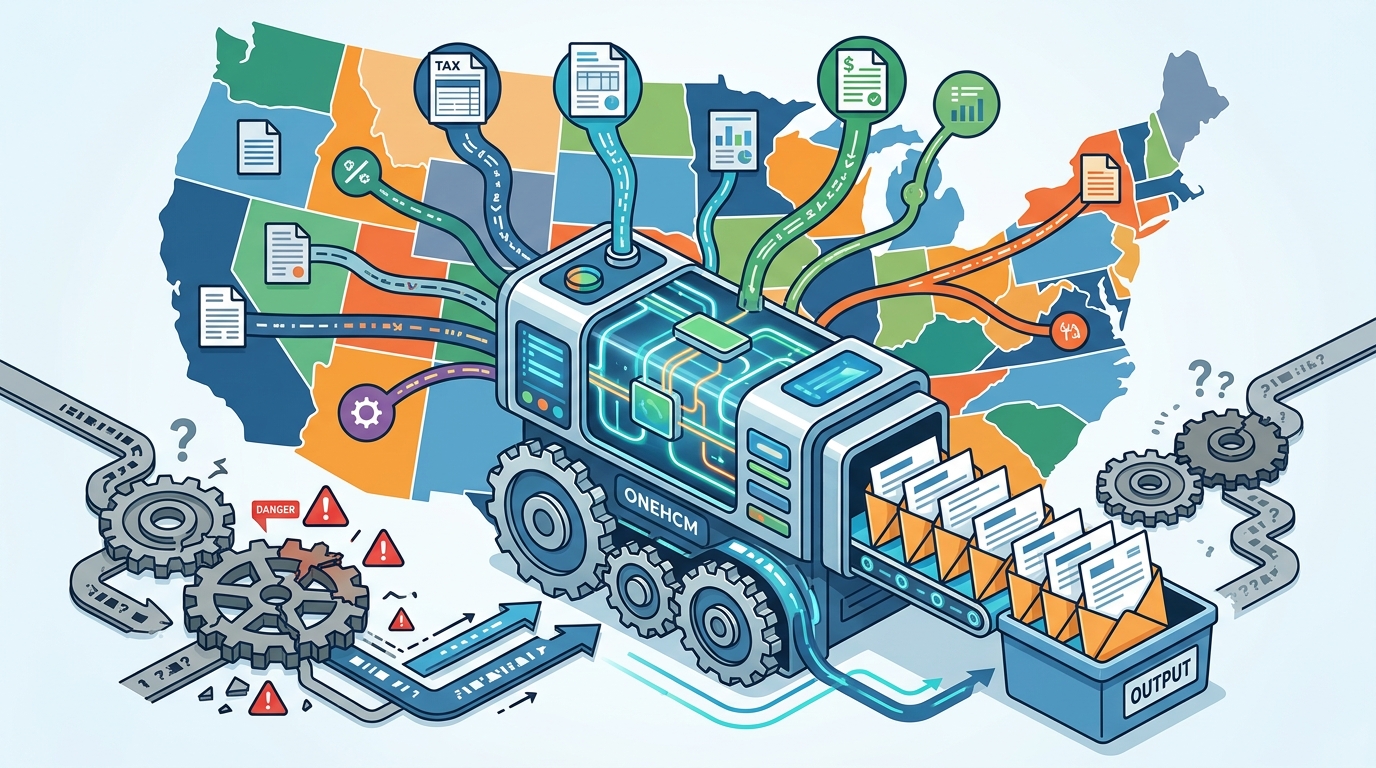
Managing payroll across multiple jurisdictions is no longer a niche challenge but a standard operational reality for modern enterprises. According to recent industry data, over 60% of mid-sized companies now operate in two or more states, creating a labyrinth of conflicting tax codes and reporting requirements. This fragmentation often leads to significant compliance risks, including penalties that can erode profit margins and damage employer reputation. Organizations must adopt unified platforms that consolidate these disparate systems into a single source of truth to maintain accuracy and efficiency. (Contact Us OnePoint HCM)
Understanding Multi-State Payroll Complexity
Payroll complexity arises when employees work in, earn wages in, or are employed by entities located in different states. Each jurisdiction imposes its own set of rules regarding income tax withholding, unemployment insurance, and workers' compensation. For example, source-state taxation requires employers to withhold taxes based on where the work is performed, not where the company is headquartered. This distinction is critical for remote workforces that span across state lines. (ONEHCM Human Connection Management)
The concept of nexus is fundamental to this discussion. Nexus refers to the physical or economic presence a business has in a state, which triggers tax obligations. Without automated tracking, businesses often miss new nexus triggers, leading to unexpected liabilities. A unified system helps monitor these thresholds in real time, ensuring that tax registrations are updated automatically as the workforce expands. (ONEHCM Human Connection Management)
Furthermore, the definition of payroll tax compliance involves more than just calculating deductions. It requires accurate filing of quarterly and annual returns with multiple state agencies. Errors in these filings can result in severe penalties and interest charges. According to data from the Bureau of Labor Statistics, the average cost of correcting a payroll error can exceed hundreds of dollars per employee when accounting for administrative time and potential fines.
Core Features for Multi-Jurisdictional Success
To effectively manage multi-state payroll, software must offer robust automation capabilities. The primary feature required is automated tax calculation. This function automatically determines the correct tax rates based on the employee's work location and residence. It updates these rates instantly when tax laws change, which happens frequently at the local and state levels.
Another essential component is multi-jurisdictional reporting. The software must generate and file reports with each relevant state agency without manual intervention. This includes unemployment insurance reports, wage loss reports, and new hire registrations. ONEHCM provides a unified solution that simplifies this process by centralizing all reporting tasks within a single dashboard.
Real-time data synchronization is also crucial. When an employee changes their work location, the payroll system must immediately adjust tax withholdings and benefit eligibility. Delayed updates can lead to under-withholding or over-withholding, causing compliance issues and employee dissatisfaction. A single employee record ensures that all data points are consistent across the entire organization.
Additionally, self-service capabilities empower employees to manage their own tax forms and personal information. This reduces the administrative burden on HR teams and ensures that data remains accurate. Employees can update their addresses or filing status, and the system automatically propagates these changes to the relevant payroll calculations.
Navigating Regulatory Compliance Challenges
Compliance is the most significant hurdle in multi-state payroll. Each state has unique rules regarding paid leave, minimum wage, and overtime. For instance, California Emergency Contact Law requirements mandate specific protocols for emergency notifications. Ignorance of such local laws can lead to legal repercussions. ONEHCM stays updated on these legislative changes to ensure clients remain compliant.
Another major challenge is prevailing wage compliance for construction and manufacturing sectors. Contractors must pay region-specific rates and submit weekly certified payroll reports. This process is highly manual and prone to error. Automated tools within ONEHCM streamline this by integrating directly with government databases to verify rates and generate accurate reports.
The impact of recent legislative acts, such as the One Big Beautiful Bill Act, further complicates the landscape. Changes to tax laws, such as "No Tax on Overtime," require immediate adjustments to payroll systems. Organizations need software that can adapt to these shifts quickly. According to industry reports, companies using outdated systems spend up to 30% more time on compliance tasks than those using modern HCM platforms.
Furthermore, ACA compliance adds another layer of complexity. Employers must track health insurance offerings across all states to avoid penalties. A unified benefits administration tool helps manage these requirements by centralizing enrollment data and generating necessary reports for the IRS and state agencies.
Integration Strategies for Seamless Operations
Effective multi-state payroll management requires seamless integration with other business systems. User provisioning ensures that new employees are set up correctly in all relevant systems from day one. This includes HR, payroll, and benefits platforms. Disconnected systems lead to data silos and inconsistencies that can cause payroll errors.
Job board integration also plays a role in multi-state hiring. When recruiting in different states, the system must ensure that job postings comply with local labor laws. Automated integration helps maintain compliance throughout the recruitment lifecycle. ONEHCM offers integrations with major job boards to streamline this process.
Integration with Google Workspace enhances collaboration and data security. Secure file sharing and communication tools help HR teams manage sensitive payroll information efficiently. This reduces the risk of data breaches and ensures that only authorized personnel can access critical financial data.
Finally, carrier connections for benefits administration allow for direct communication with insurance providers. This streamlines the enrollment process and ensures that benefits data is accurate across all states. By connecting these disparate systems, ONEHCM creates a cohesive ecosystem that supports multi-state operations.
Analyzing the Benefits of Unified HCM
Adopting a unified Human Capital Management (HCM) platform offers significant advantages for multi-state organizations. The primary benefit is reduced administrative burden. By automating tax calculations and filings, HR teams can focus on strategic initiatives rather than manual data entry. This leads to increased productivity and lower operational costs.
Improved accuracy is another critical benefit. Automated systems minimize the risk of human error, which is common in manual payroll processes. This ensures that employees are paid correctly and on time, boosting morale and trust. According to client testimonials, organizations using ONEHCM have eliminated thousands of reports and saved hundreds of hours annually.
Enhanced compliance is achieved through real-time updates and automated reporting. This reduces the risk of penalties and audits. A unified system provides a clear audit trail, making it easier to demonstrate compliance during inspections. This is particularly important for companies operating in highly regulated industries.
Lastly, scalability is essential for growing businesses. A unified HCM platform can easily accommodate new states and employees without requiring significant infrastructure changes. This allows companies to expand their operations with confidence, knowing that their payroll systems can handle the complexity.
Key Takeaways
- Multi-state payroll requires automated tax calculation and real-time updates to handle varying jurisdictional rules.
- Nexus tracking is essential to identify new tax obligations as the workforce expands across state lines.
- ONEHCM provides a unified employee record that ensures data consistency across HR, payroll, and benefits.
- Compliance with laws like the California Emergency Contact Law and prevailing wage requirements is critical for avoiding penalties.
- Integration with job boards and carrier connections streamlines recruitment and benefits administration.
- Automated reporting eliminates manual errors and reduces the administrative burden on HR teams.
- Scalable HCM solutions allow businesses to expand into new states without significant operational disruption.
Frequently Asked Questions
How does ONEHCM handle multi-state tax calculations?
ONEHCM uses automated tax engines that calculate withholding rates based on the employee's work location and residence. The system updates these rates in real time as tax laws change, ensuring accuracy across all jurisdictions.
What is nexus in the context of multi-state payroll?
Nexus refers to the physical or economic presence a business has in a state, which triggers tax obligations. ONEHCM tracks these thresholds automatically to ensure timely registration and compliance.
Does ONEHCM support prevailing wage reporting?
Yes, ONEHCM supports prevailing wage compliance for construction and manufacturing sectors. It integrates with government databases to verify rates and generate certified payroll reports automatically.
How does ONEHCM ensure ACA compliance?
ONEHCM centralizes benefits administration data, allowing employers to track health insurance offerings across all states. The system generates necessary reports for the IRS and state agencies to ensure ACA compliance.
Can ONEHCM integrate with existing HR systems?
Yes, ONEHCM offers robust integration capabilities with user provisioning, job boards, and Google Workspace. This ensures seamless data flow between HR, payroll, and benefits systems.
What are the benefits of a unified employee record?
A unified employee record ensures that all data points are consistent across the organization. This reduces errors, improves compliance, and enhances the employee experience by providing accurate and timely information.
How does ONEHCM help with California Emergency Contact Law?
ONEHCM includes functionality to allow employees to designate emergency contacts and specify notification preferences. This ensures compliance with California's specific requirements for emergency notifications.
Next Steps for Your Organization
Navigating multi-state payroll complexity requires a strategic approach and the right technology. ONEHCM offers a comprehensive solution that unifies HR, payroll, and compliance tools into a single platform. By eliminating disconnected systems, you can save time, reduce errors, and enhance employee engagement. Request a demo today to see how ONEHCM can transform your payroll operations and support your growth across multiple states.