

Managing payroll across multiple jurisdictions is no longer a niche challenge; it is a standard operational reality for modern enterprises. According to recent industry analyses, over 60% of mid-sized companies now operate in two or more states, creating a labyrinth of conflicting tax codes and reporting requirements. This fragmentation often leads to significant compliance risks, including penalties that can erode profit margins and damage employer reputation. Organizations must transition from manual spreadsheets to unified platforms that automate these intricate calculations while maintaining data integrity. (Contact Us OnePoint HCM)
Understanding Multi-State Payroll Complexity
Payroll complexity arises when employees work across different geographic boundaries. Each state maintains its own tax rates, withholding limits, and filing frequencies. Multi-state payroll complexity is the challenge of accurately calculating and remitting these varying obligations without error. When a company expands its footprint, the administrative burden grows exponentially. (Meet the ONEHCM Team)
Consider the concept of nexus. Nexus is the legal connection between a business and a state that obligates the business to collect and remit taxes. Establishing nexus can happen through physical presence, such as an office, or economic activity, like sales volume. Once nexus is established, the employer must register with the state’s revenue department and adhere to its specific payroll tax rules. (ONEHCM Human Connection Management)
Another critical factor is reciprocal agreements. These are treaties between neighboring states that allow workers to pay income tax only to their state of residence, rather than their state of work. Navigating these agreements manually is prone to error. A robust system must automatically detect these relationships and adjust withholding accordingly. Without this automation, companies risk over-withholding or under-withholding, leading to employee dissatisfaction and audit flags. (ONEHCM Human Connection Management)
The rise of remote work has further complicated this landscape. Employees working from home in a different state than their employer creates a new nexus point. This shift means that a single employee can trigger tax obligations in multiple jurisdictions. Companies must track not just where the employee works, but where they work each day. This granular tracking requires software capable of real-time updates and precise proration of taxes.
Key Features for Regulatory Compliance
To manage these challenges effectively, payroll software must offer specific capabilities designed for multi-jurisdictional environments. The first essential feature is automated tax filing. This function ensures that returns are prepared and submitted to the correct agencies by their deadlines. Manual filing increases the risk of late penalties, which can accumulate quickly across multiple states.
Accurate tax calculation is equally important. The software must apply the correct local, state, and federal tax rates based on the employee’s work location and residence. It should also handle local ordinances, such as city-specific taxes or school district levies. These micro-jurisdictions add another layer of complexity that generic tools often miss.
Reporting flexibility is another non-negotiable requirement. Different states require different report formats and submission methods. Some states mandate electronic filing, while others still accept paper. The system must generate these reports in the exact format required by each jurisdiction. Additionally, it should provide a centralized dashboard for viewing all tax liabilities and payments in one place. (8 4 1)
Compliance updates are vital in a changing regulatory environment. Tax laws change frequently, often mid-year. The software must automatically update its tax tables and rules to reflect these changes. This ensures that calculations remain accurate without manual intervention from the HR team. Failure to update these tables can result in systematic underpayment of taxes across the entire organization.
The ONEHCM Unified Approach
ONEHCM addresses these challenges through its Human Connection Management philosophy. Unlike fragmented systems that require separate modules for HR and payroll, ONEHCM unifies these functions into a single platform. This integration eliminates data silos and ensures that payroll data is always accurate and up-to-date.
At the core of ONEHCM is the One Employee Record. This unified profile stores all employee data, including work locations, tax exemptions, and benefit elections. When an employee changes their work location, the system automatically updates their tax profile. This real-time synchronization prevents errors that often occur when data is transferred between disparate systems.
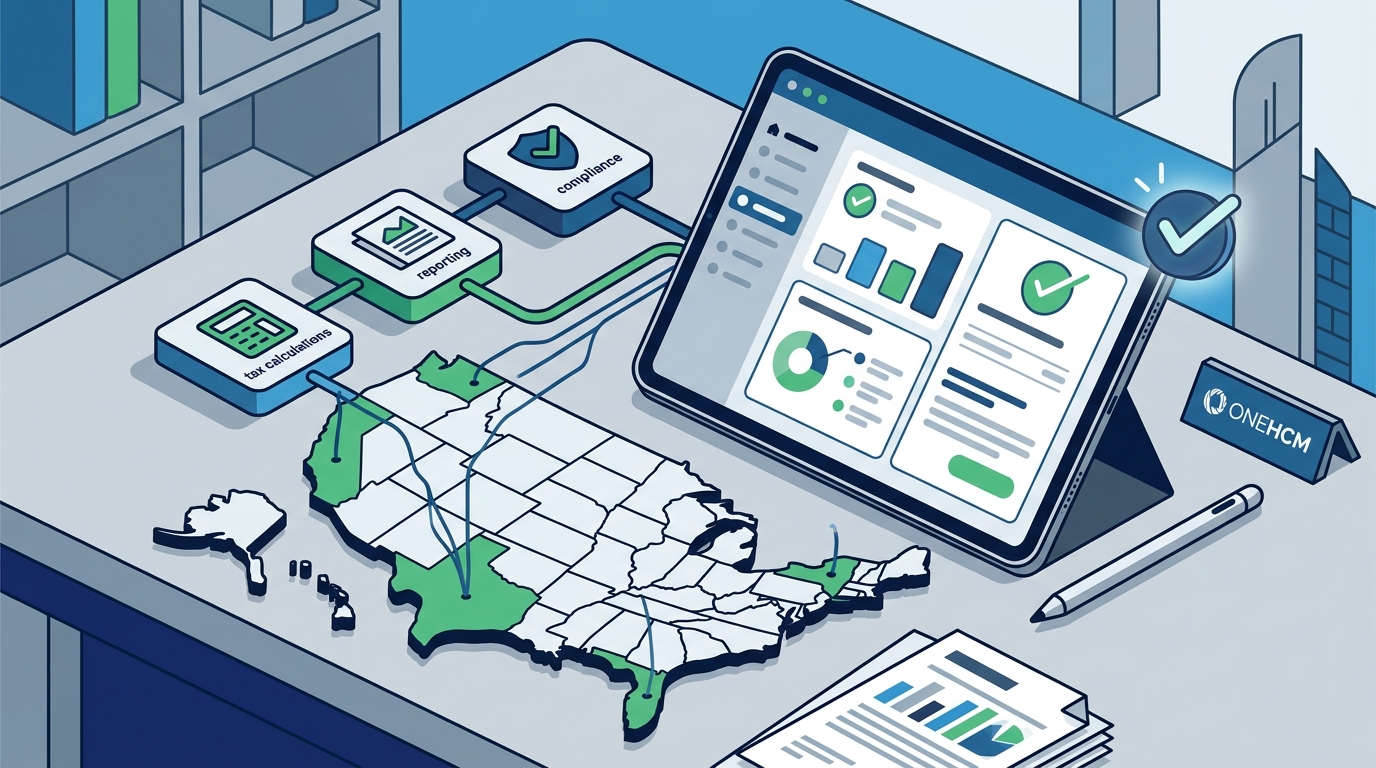
ONEHCM’s payroll engine is designed to handle multi-state complexities seamlessly. It automatically calculates taxes based on the employee’s current work location and residence. The system also manages reciprocal agreements and nexus rules, ensuring that withholding is accurate for every jurisdiction. This automation reduces the administrative burden on HR teams, allowing them to focus on strategic initiatives rather than compliance details.
Furthermore, ONEHCM provides robust reporting capabilities. Users can generate state-specific tax reports with a few clicks. The system also supports automated filing, reducing the risk of late submissions. For companies with employees in numerous states, this feature is invaluable. It ensures that all filings are consistent and accurate, regardless of the number of jurisdictions involved. (8 4 1)
The platform also offers dedicated support for complex scenarios. ONEHCM’s team of experts helps clients navigate specific state requirements and regulatory changes. This personalized support ensures that companies remain compliant even as they expand into new markets. By combining technology with human expertise, ONEHCM provides a comprehensive solution for multi-state payroll management.
Integration and Data Flow
Effective multi-state payroll management requires seamless data flow across the organization. ONEHCM integrates with a wide range of third-party applications, including job boards, user provisioning tools, and carrier connections. These integrations ensure that data moves smoothly between systems, reducing manual entry and the associated errors.
For example, when a new employee is onboarded, their information is automatically synced to the payroll system. This includes their work location, which triggers the appropriate tax calculations. Similarly, changes in benefits or leave status are reflected in real-time, ensuring that payroll deductions are accurate. This level of integration is critical for maintaining data integrity across multiple states.
ONEHCM also supports Google Workspace integration, allowing HR teams to collaborate more effectively. Employees can access their pay stubs and tax documents directly through their preferred workspace. This accessibility improves the employee experience and reduces the volume of inquiries to the HR department. It also ensures that employees have accurate information for their personal tax filings.
The platform’s API capabilities allow for custom integrations tailored to specific business needs. This flexibility ensures that ONEHCM can adapt to unique workflows and data requirements. Whether a company uses specialized time-tracking tools or custom HRIS solutions, ONEHCM can connect with them to create a unified payroll ecosystem.
Industry-Specific Payroll Needs
Different industries face unique payroll challenges. ONEHCM offers specialized solutions for various sectors, including healthcare, manufacturing, and non-profits. Each industry has specific compliance requirements that must be addressed to ensure accurate payroll processing.
For the healthcare industry, payroll complexity often involves shift differentials and on-call pay. ONEHCM’s time and labor module accurately tracks these hours and applies the correct pay rates. The system also handles complex benefit deductions, such as union dues and health insurance premiums, ensuring that they are calculated correctly for each state.
Manufacturing companies often deal with piece-rate pay and prevailing wage laws. ONEHCM supports piece-rate calculations, ensuring that workers are paid accurately for their output. For government-funded projects, the system handles certified payroll reporting, which requires detailed documentation of wages and benefits. This capability is essential for maintaining compliance with federal and state regulations.
Non-profit organizations have unique tax-exempt status requirements. ONEHCM helps these organizations navigate their specific tax obligations, ensuring that they remain compliant while maximizing their resources. The platform also supports grant reporting, allowing non-profits to track payroll costs associated with specific funding sources. This level of detail is crucial for financial transparency and accountability.
Key Takeaways
- Multi-state payroll complexity involves managing varying tax codes, nexus rules, and reciprocal agreements across jurisdictions.
- Automated tax filing and calculation are essential to prevent penalties and ensure compliance.
- ONEHCM’s One Employee Record ensures real-time synchronization of employee data across all systems.
- Integrated support for reciprocal agreements and nexus tracking reduces manual administrative burden.
- Industry-specific modules address unique needs in healthcare, manufacturing, and non-profits.
- Seamless integration with Google Workspace and third-party tools enhances data accuracy.
- Personalized expert support helps organizations navigate complex regulatory landscapes.
Frequently Asked Questions
How does ONEHCM handle reciprocal agreements?
ONEHCM automatically detects reciprocal agreements between states and adjusts tax withholding accordingly. This ensures that employees pay tax only to their state of residence when applicable, preventing over-withholding and compliance errors.
What is nexus and why does it matter for payroll?
Nexus is the legal connection between a business and a state that obligates the business to collect and remit taxes. Establishing nexus triggers tax obligations in that state, requiring accurate payroll processing and reporting to avoid penalties.
Can ONEHCM manage certified payroll for construction?
Yes, ONEHCM supports certified payroll reporting for government-funded projects. The system generates the required weekly reports detailing wages, benefits, and prevailing wage compliance, ensuring adherence to federal and state regulations.
How does ONEHCM ensure tax table accuracy?
ONEHCM automatically updates its tax tables to reflect changes in state and local tax laws. This ensures that payroll calculations remain accurate without manual intervention, reducing the risk of compliance errors.
Does ONEHCM offer support for piece-rate pay?
Yes, ONEHCM’s time and labor module accurately tracks piece-rate hours and calculates pay based on output. This feature is particularly useful for manufacturing and retail industries where compensation is tied to production.
What integrations does ONEHCM support?
ONEHCM integrates with job boards, user provisioning tools, carrier connections, and Google Workspace. These integrations ensure seamless data flow and reduce manual entry errors across the organization.
How does ONEHCM help with remote work compliance?
ONEHCM tracks employee work locations in real-time and updates tax profiles accordingly. This ensures that payroll is accurate for employees working from different states, managing nexus and withholding requirements automatically.
Next Steps
Managing multi-state payroll does not have to be a source of stress. ONEHCM provides the tools, expertise, and support needed to navigate this complexity with confidence. By unifying HR, payroll, and compliance into a single platform, ONEHCM helps organizations save time, reduce errors, and enhance employee engagement.
Ready to simplify your payroll processes? Request a Demo today to see how ONEHCM can transform your workforce management. Our team is ready to help you build a compliant, efficient, and human-centric payroll system.