

Managing payroll across multiple jurisdictions is no longer a simple calculation task. It is a complex web of varying tax rates, filing frequencies, and regulatory updates that can cripple an organization's operational efficiency. According to recent industry data, payroll compliance errors cost businesses an average of $1,000 per employee annually in penalties and remediation costs. This financial burden is exacerbated by the rapid expansion of remote work, which has forced companies to hire talent in states with entirely different labor laws. Without a unified system, HR teams are left manually reconciling discrepancies that could have been automated. (Contact Us OnePoint HCM)
What Is Multi-State Payroll Complexity?
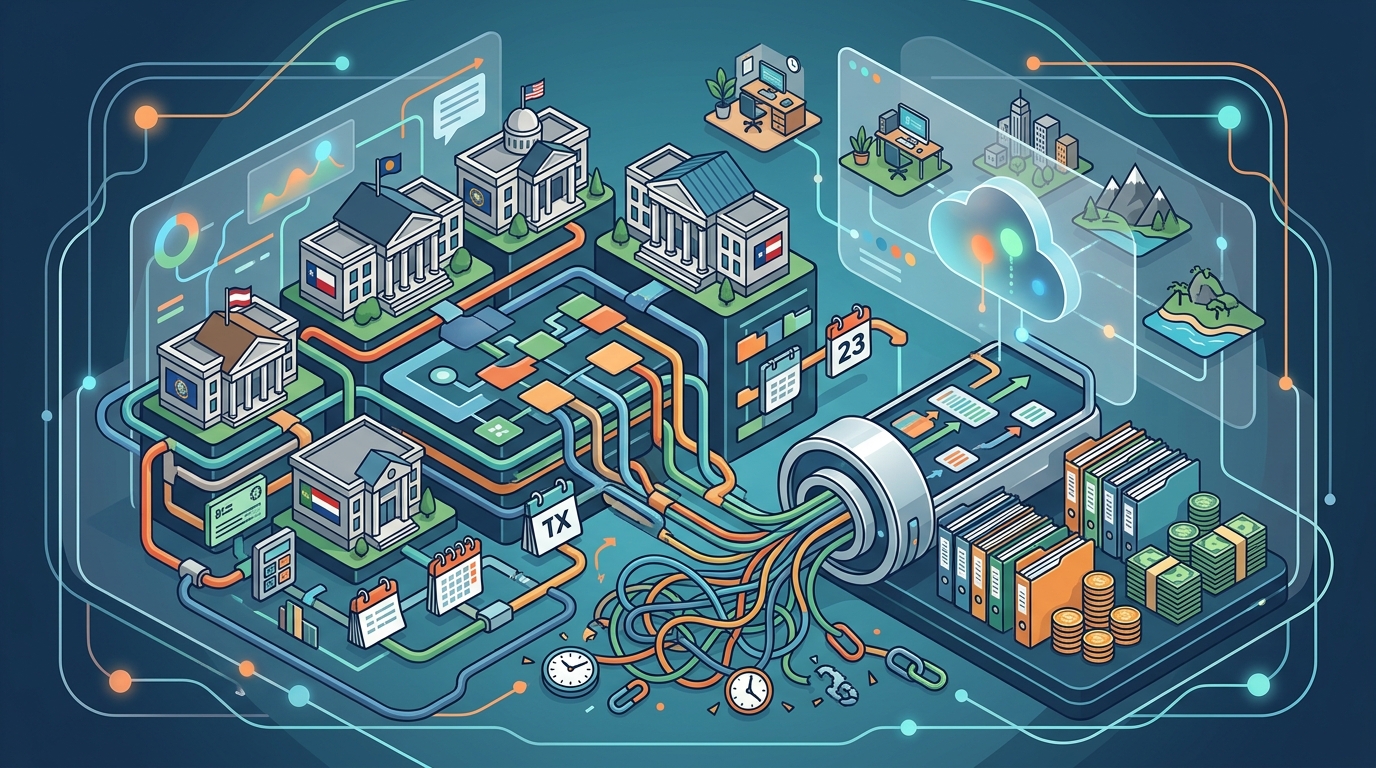
Multi-state payroll complexity refers to the operational difficulty of processing wages for employees located in different geographic jurisdictions. Each state in the United States has its own set of rules regarding income tax withholding, unemployment insurance, and workers' compensation. Data from the Bureau of Labor Statistics shows that remote work adoption has increased by over 150% since 2020, fundamentally changing where employees work and where their taxes are owed. This shift means that a company headquartered in one state may now have employees in dozens of others, each requiring distinct tax filings and compliance reports.
Payroll complexity is not just about tax rates. It involves understanding nexus, which is the legal connection between a business and a state that triggers tax obligations. If a company exceeds a certain threshold of employee presence or revenue in a state, it must register and begin withholding taxes there. Failure to do so can result in severe penalties and back taxes. The definition of payroll complexity is the accumulation of these varying regulatory requirements that must be met simultaneously to ensure legal compliance and accurate employee compensation.
Key Challenges in Multi-Jurisdictional Payroll
Tax Rate Variations and Updates
Tax rates vary significantly from state to state and even within cities. For example, local taxes in New York City or Philadelphia add layers of complexity that do not exist in other regions. These rates are not static. They change annually or even mid-year based on legislative decisions. The Tax Foundation reports that state and local tax burdens vary by over 10% depending on the jurisdiction. Keeping track of these changes manually is nearly impossible for growing companies. One missed update can lead to under-withholding, which triggers employee dissatisfaction and potential audits.
Compliance and Filing Frequencies
Different states have different filing frequencies. Some require monthly filings, while others allow quarterly or annual submissions. This inconsistency creates a chaotic calendar for payroll administrators. The Department of Labor emphasizes that accurate record-keeping is critical for wage and hour compliance. When payroll is managed across multiple states, the risk of missing a filing deadline increases exponentially. A late filing can result in penalties that compound over time, eating into the company's profit margins.
Remote Work and Nexus Issues
The rise of remote work has created new nexus issues. Companies must determine if they have a physical or economic presence in a state. This determination dictates whether they must withhold taxes and pay unemployment insurance in that location. Research from the National Association of State Budget Officers indicates that state tax revenues are increasingly dependent on accurate nexus determinations. Without automated tools to track employee locations, companies risk creating unintended tax liabilities in states where they did not plan to operate.
How ONEHCM Solves Multi-State Payroll
ONEHCM addresses these challenges by providing a unified platform that automates the complexities of multi-state payroll. The system is designed to handle the intricacies of tax calculations, filings, and compliance without requiring manual intervention for every change. By centralizing payroll data, ONEHCM ensures that every employee's wages are processed according to their specific location's rules.
Automated Tax Calculations and Filings
ONEHCM's payroll module automatically calculates taxes based on the employee's work location. This means that if an employee moves to a different state, the system updates the tax rates and withholding amounts in real time. The platform also handles the filing of tax returns with the appropriate state agencies. This automation reduces the risk of human error and ensures that filings are submitted on time. The IRS provides guidelines on federal tax compliance, which ONEHCM integrates with state-specific requirements to create a comprehensive compliance framework.
Unified Employee Records
One of the core strengths of ONEHCM is the One Employee Record. This feature ensures that all employee data, including tax information and benefits, is stored in a single location. This unified view allows HR and payroll teams to manage multi-state employees with ease. SHRM highlights that unified HR systems reduce administrative overhead by up to 30%. With ONEHCM, payroll administrators can access all necessary information without switching between multiple software applications.
Compliance Monitoring and Alerts
ONEHCM continuously monitors regulatory changes across all states where the company has employees. The system provides alerts for new laws or updates to existing regulations. This proactive approach ensures that the company remains compliant at all times. According to the Bureau of Labor Statistics, labor laws are updated frequently to reflect changing economic conditions. ONEHCM's compliance engine translates these updates into actionable changes within the payroll system, protecting the business from potential penalties.
Integration Capabilities for Seamless Data Flow
Payroll does not exist in a vacuum. It must integrate with other business systems to ensure accurate data flow. ONEHCM offers robust integration capabilities that connect payroll with HR, benefits, and time & labor modules. This seamless integration ensures that data entered in one module is automatically reflected in others, reducing the need for manual data entry.
Third-Party Integrations
ONEHCM integrates with a wide range of third-party applications, including job boards, user provisioning tools, and carrier connections. The ONEHCM Integration Directory provides a comprehensive list of supported third-party tools. These integrations allow companies to streamline their workflows and reduce the risk of data silos. For example, time tracking data can be automatically transferred to payroll, ensuring that employees are paid accurately for their hours worked.
Real-Time Data Synchronization
Real-time data synchronization is critical for multi-state payroll. Delays in data transfer can lead to errors in tax calculations and filings. ONEHCM's cloud-based architecture ensures that data is synchronized in real time across all modules. This ensures that payroll runs are accurate and up to date. Gartner notes that cloud-based solutions offer superior data synchronization capabilities compared to on-premise systems. This advantage is particularly important for companies managing complex multi-state payroll operations.
Multi-State Payroll Solutions Comparison
Choosing the right payroll software is a critical decision. The table below compares ONEHCM with traditional payroll methods and other common solutions.
| Feature | ONEHCM | Traditional Spreadsheets | Legacy Payroll Systems |
|---|---|---|---|
| Multi-State Tax Automation | Yes, fully automated | No, manual calculation | Partial, often requires updates |
| Unified Employee Record | Yes, single source of truth | No, fragmented data | Often siloed by module |
| Compliance Monitoring | Real-time alerts | None | Periodic updates |
| Integration Capabilities | Extensive, including Carrier Connections | Limited | Varies by vendor |
| User Experience | Self-service portal for employees | Complex, admin-heavy | Often outdated interface |
Key Takeaways
- Multi-state payroll complexity involves managing varying tax rates, filing frequencies, and nexus rules across different jurisdictions.
- Payroll compliance errors can cost businesses an average of $1,000 per employee annually in penalties and remediation.
- ONEHCM provides a unified platform that automates tax calculations, filings, and compliance monitoring for multi-state operations.
- The One Employee Record feature ensures that all employee data is stored in a single location, reducing administrative overhead.
- ONEHCM integrates with a wide range of third-party applications, including Carrier Connections, to streamline workflows.
- Real-time data synchronization is critical for accurate payroll processing and is supported by ONEHCM's cloud-based architecture.
- Proactive compliance monitoring helps companies stay ahead of regulatory changes and avoid potential penalties.
Frequently Asked Questions
How does ONEHCM handle tax updates for different states?
ONEHCM automatically updates tax rates and regulations for all states where the company has employees. The system monitors regulatory changes and applies the necessary updates to payroll calculations in real time, ensuring compliance without manual intervention.
What is the One Employee Record?
The One Employee Record is a centralized database that stores all employee information, including personal details, tax data, and benefits. This unified view allows HR and payroll teams to manage employee data efficiently and accurately across multiple states.
Can ONEHCM integrate with our existing HR systems?
Yes, ONEHCM offers robust integration capabilities with a wide range of third-party applications. The Integration Directory lists all supported tools, ensuring seamless data flow between payroll, HR, and other business systems.
How does ONEHCM help with remote work compliance?
ONEHCM tracks employee locations and automatically adjusts tax withholdings and filings based on the employee's work state. This ensures that companies comply with nexus rules and avoid unintended tax liabilities in states where they have remote employees.
What are the benefits of using a unified payroll system?
A unified payroll system reduces administrative overhead, minimizes errors, and improves compliance. By consolidating HR, payroll, and benefits into one platform, companies can streamline their operations and focus on strategic initiatives rather than manual data entry.
Does ONEHCM offer support for multi-state benefits administration?
Yes, ONEHCM includes comprehensive benefits administration tools that support multi-state requirements. The system helps manage benefits enrollment, ACA compliance, and carrier connections across different jurisdictions.
How does ONEHCM ensure data security for payroll information?
ONEHCM employs industry-standard security measures to protect payroll data. The platform uses encryption, access controls, and regular security audits to ensure that sensitive employee information is kept safe and compliant with data protection regulations.
What industries benefit most from ONEHCM's multi-state payroll features?
Industries with distributed workforces, such as healthcare, manufacturing, and retail, benefit significantly from ONEHCM's multi-state payroll features. The platform's flexibility and compliance tools make it ideal for companies operating across multiple jurisdictions.
Streamline Your Payroll Today
Managing multi-state payroll does not have to be a source of stress and complexity. ONEHCM provides the tools, automation, and expertise needed to handle the intricacies of multi-jurisdictional payroll with ease. By choosing ONEHCM, you gain a dedicated partner committed to your success. Request a demo today to see how ONEHCM can transform your payroll operations and help your business thrive in a remote-first world.