

California construction firms face some of the most rigorous payroll compliance standards in the United States. Recent legislative updates have tightened enforcement on prevailing wage laws, requiring contractors to maintain meticulous records to avoid severe penalties. According to industry data, non-compliance can result in back pay liabilities that exceed the original contract value, making accurate certified payroll processing a critical operational necessity rather than an administrative afterthought. (Contact Us OnePoint HCM)
Understanding Certified Payroll Requirements
Certified payroll is not merely a standard payroll run. It is a detailed reporting mechanism required for public works projects. Certified payroll is a formal documentation process that proves contractors are paying workers the legally mandated prevailing wages and benefits. This system ensures that public funds are used fairly and that workers receive their entitled compensation. (ONEHCM Human Connection Management)
For construction companies, this involves submitting weekly reports to the relevant public agency. These reports must include specific data points such as worker classifications, hours worked, and rates of pay. Failure to submit these reports accurately and on time can lead to stop-work orders, fines, and debarment from future government contracts.
The complexity arises because prevailing wage rates vary by county, trade, and even year. A single project might involve dozens of different job classifications, each with its own wage and benefit package. Managing this manually through spreadsheets is prone to error and incredibly time-consuming.
California-Specific Regulatory Challenges
California has historically been a leader in labor protections, which translates to complex payroll requirements for construction firms. The state enforces strict prevailing wage laws under the Department of Industrial Relations (DIR). Prevailing wage laws require contractors on government-funded projects to pay workers region-specific rates, while certified payroll is the weekly reporting that proves compliance.
Recent updates to California law have further complicated the landscape. For instance, the California Emergency Contact Law now requires employers to allow employees to designate an emergency contact and specify notification preferences. This adds another layer of data management to the payroll process.
Additionally, the signing of the One Big Beautiful Bill Act (OBBBA) on July 4, 2025, introduced significant changes to payroll tax structures. While the act promised "No Tax on Overtime" and "No Tax on Tips," the implementation details require careful navigation to ensure compliance with both state and federal guidelines. Contractors must adjust their payroll systems to reflect these changes accurately.
Another critical aspect is the enforcement of piece rate pay regulations. California requires that piece rate workers receive a separate, hourly minimum wage for non-productive time. This dual-rate calculation must be handled seamlessly within the payroll system to avoid wage and hour violations.
Key Features Essential for Construction Payroll
When evaluating payroll solutions for construction, certain features are non-negotiable. The software must handle the intricacies of prevailing wage calculations, multi-state compliance, and real-time reporting.
Automated Prevailing Wage Calculations
The best solutions automatically update prevailing wage rates based on the project location and worker classification. This eliminates the need for manual data entry and reduces the risk of errors. Automated calculations ensure that workers are paid the correct rate for their specific trade and county.
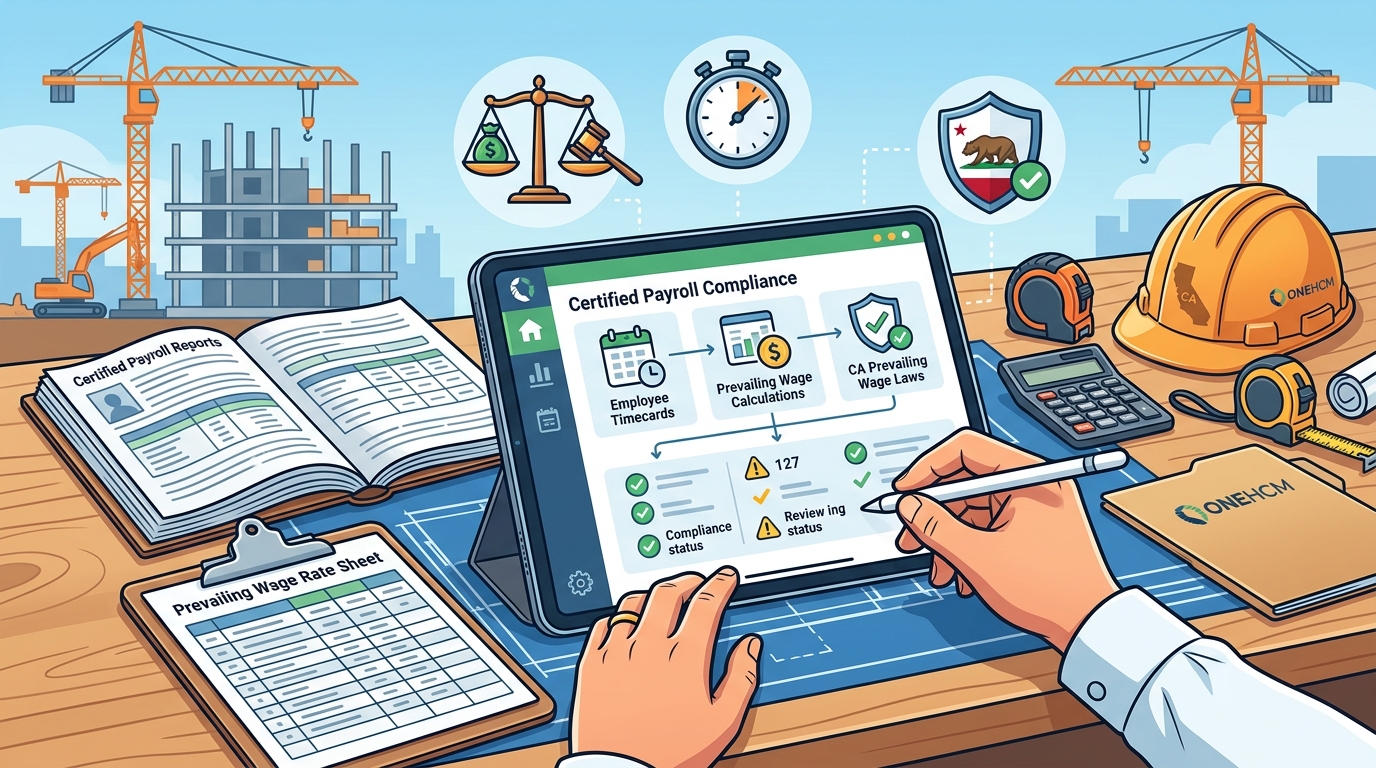
Integrated Certified Payroll Reporting
Seamless integration with government reporting portals is essential. The system should generate certified payroll reports in the exact format required by the relevant public agency. This includes support for standard forms like the US Department of Labor's WH-347 form.
Real-Time Compliance Monitoring
Real-time monitoring allows project managers and HR teams to identify potential compliance issues before they become problems. This includes tracking overtime, ensuring proper classifications, and verifying that all required benefits are being contributed.
How ONEHCM Addresses These Needs
ONEHCM offers a comprehensive Human Connection Management platform designed to unify HR, payroll, time & labor, and benefits administration. For construction companies, this unified approach is particularly valuable.
Unified Employee Record
ONEHCM utilizes a One Employee Record architecture. This means that data entered once is accessible across all modules, including recruitment, onboarding, timekeeping, and payroll. This eliminates data silos and ensures consistency across the organization.
Advanced Time & Labor Tracking
Accurate time tracking is the foundation of certified payroll. ONEHCM provides robust timekeeping tools that support mobile time clocks, GPS tracking, and real-time scheduling. This ensures that hours worked are captured accurately and can be easily mapped to prevailing wage classifications.
Seamless Payroll Integration
ONEHCM ensures accurate payroll runs by seamlessly sharing information between timekeeping and payroll modules. This integration reduces manual data entry and minimizes the risk of errors. The system also supports piece rate pay calculations, which is crucial for California compliance.
Compliance and Reporting
ONEHCM offers dedicated compliance tools that help contractors stay up-to-date with changing regulations. This includes automated updates to prevailing wage rates and support for generating certified payroll reports in various formats. The platform also integrates with carrier connections for benefits administration, ensuring that all required contributions are tracked.
For more details on how ONEHCM supports construction companies, you can explore our Manufacturing and Construction Solutions page.
Solution Comparison Matrix
Choosing the right payroll solution requires comparing key features across different providers. The table below highlights the differences between traditional payroll systems and a unified HCM platform like ONEHCM.
| Feature | Traditional Payroll Software | ONEHCM Unified Platform |
|---|---|---|
| Data Silos | High risk of disconnected data | Single source of truth |
| Prevailing Wage Updates | Manual or limited automation | Automated and real-time |
| Certified Payroll Reporting | Manual export and formatting | Integrated and automated |
| Compliance Monitoring | Reactive and periodic | Proactive and real-time |
| Support Model | Generic customer service | Dedicated partner approach |
For a deeper dive into our service commitment, visit our Why ONEHCM page.
Key Takeaways
- Certified payroll is mandatory for public works projects in California and requires precise weekly reporting.
- Prevailing wage rates vary by county and trade, necessitating automated updates to avoid compliance errors.
- California's recent legislative changes, including the One Big Beautiful Bill Act, have increased the complexity of payroll tax compliance.
- ONEHCM's unified platform eliminates data silos by maintaining a single employee record across all HR functions.
- Real-time time tracking and automated reporting are essential for reducing the administrative burden of certified payroll.
- Dedicated support and industry-specific expertise are critical for navigating complex regulatory environments.
- Consolidating HR, payroll, and benefits into one system improves efficiency and reduces the risk of penalties.
Frequently Asked Questions
What is certified payroll?
Certified payroll is a formal documentation process that proves contractors are paying workers the legally mandated prevailing wages and benefits. It involves submitting detailed weekly reports to public agencies.
Why is certified payroll important for construction companies?
It ensures compliance with federal and state labor laws, preventing fines, back pay liabilities, and debarment from future government contracts.
How does California's prevailing wage law affect payroll?
California requires contractors to pay region-specific rates based on the worker's trade and county. This necessitates frequent updates to payroll systems to reflect current wage determinations.
What are the consequences of non-compliance with certified payroll?
Non-compliance can result in stop-work orders, significant fines, back pay obligations, and debarment from bidding on future public works projects.
How does ONEHCM handle prevailing wage updates?
ONEHCM automates the process of updating prevailing wage rates based on project location and worker classification, ensuring accuracy and reducing manual effort.
Can ONEHCM generate certified payroll reports?
Yes, ONEHCM supports the generation of certified payroll reports in standard formats, such as the US Department of Labor's WH-347 form, ready for submission.
What is the One Big Beautiful Bill Act?
The One Big Beautiful Bill Act (OBBBA) is legislation signed in 2025 that introduced changes to payroll tax structures, including provisions for overtime and tips, impacting how contractors must manage their payroll systems.
Does ONEHCM support piece rate pay?
Yes, ONEHCM includes features for calculating piece rate pay, ensuring compliance with California regulations that require separate hourly minimum wage calculations for non-productive time.
Next Steps
Navigating the complexities of certified payroll in California requires a robust, compliant, and supportive partner. ONEHCM offers the technology and expertise to streamline your payroll processes and ensure compliance. Request a Demo today to see how ONEHCM can transform your construction payroll operations.