

Piece-rate compensation is a common model in California manufacturing, agriculture, and hospitality sectors, allowing workers to earn wages based on output rather than hours worked. However, California labor laws impose strict requirements on how these earnings interact with minimum wage, overtime, and non-working time. According to recent Department of Industrial Relations guidelines, failure to properly calculate these complex pay structures can result in significant wage and hour violations. Modern Human Capital Management (HCM) systems must bridge the gap between simple output tracking and rigorous legal compliance. (California State Payroll) (Contact Us OnePoint HCM)
Understanding Piece-Rate Pay in California
Piece-rate pay is a compensation method where employees are paid a fixed rate for each unit produced or action performed. This model is prevalent in industries such as garment manufacturing, food processing, and construction. While it can incentivize productivity, it introduces complex payroll calculations that standard time-clock systems often miss. (Meet the ONEHCM Team)
California law mandates that piece-rate workers must still receive at least the minimum wage for all hours worked, including non-productive time. This means employers must calculate an "average hourly rate" for each employee. This rate is derived by dividing total piece-rate earnings by total hours worked, including non-working time like rest breaks and mandatory training. Software that fails to automate this calculation exposes employers to severe liability. (California State Payroll)
Key Compliance Challenges
Managing piece-rate pay manually or with disjointed systems is fraught with risk. The primary challenge lies in the accurate allocation of non-productive time. When a piece-rate worker takes a break or attends a meeting, they are still entitled to minimum wage for that time. If the software does not track these hours separately, the employer may underpay the employee.
Another critical issue is overtime calculation. Overtime for piece-rate workers is not simply double the piece rate. It requires a weighted average calculation that accounts for all hours worked. Errors in this process are common in systems that do not integrate timekeeping with payroll processing. According to labor compliance experts, accurate tracking of both productive and non-productive time is the single most important factor in avoiding wage theft claims.
Essential Software Features
To handle piece-rate pay correctly, an HR and payroll platform must possess specific technical capabilities. Generic payroll tools often lack the granularity required for California's wage orders. Employers need a system that supports multiple pay rates for the same employee and automatically calculates the weighted average hourly rate.
Key features include:
- Integrated Timekeeping: The ability to track non-productive time (breaks, meetings, waiting) separately from piece-rate work.
- Automated Weighted Average Calculation: The system must automatically compute the average hourly rate for overtime and premium pay purposes.
- Real-Time Reporting: Managers need visibility into labor costs per unit to ensure profitability while maintaining compliance.
- Seamless Payroll Integration: Data must flow directly from timekeeping to payroll without manual entry errors.
How ONEHCM Handles Piece-Rate Pay
ONEHCM is designed to address these specific complexities through its unified Human Connection Management platform. Unlike fragmented systems that require separate modules for time and payroll, ONEHCM integrates these functions to ensure data accuracy. The platform supports piece-rate pay structures natively, allowing employers to set specific rates for different tasks or units.
OneHCM's timekeeping module allows employees to log both piece-rate work and non-productive time. The system then automatically calculates the weighted average hourly rate for overtime and other premium pay calculations. This automation eliminates the manual errors that often lead to compliance violations. By consolidating these processes, ONEHCM helps HR teams save time and minimize errors, as highlighted in our service commitment.
Furthermore, ONEHCM provides robust reporting tools that give employers real-time insights into labor costs. This visibility is crucial for managing profitability in piece-rate environments. The platform's piece-rate pay feature is specifically designed to handle the nuances of California wage orders.
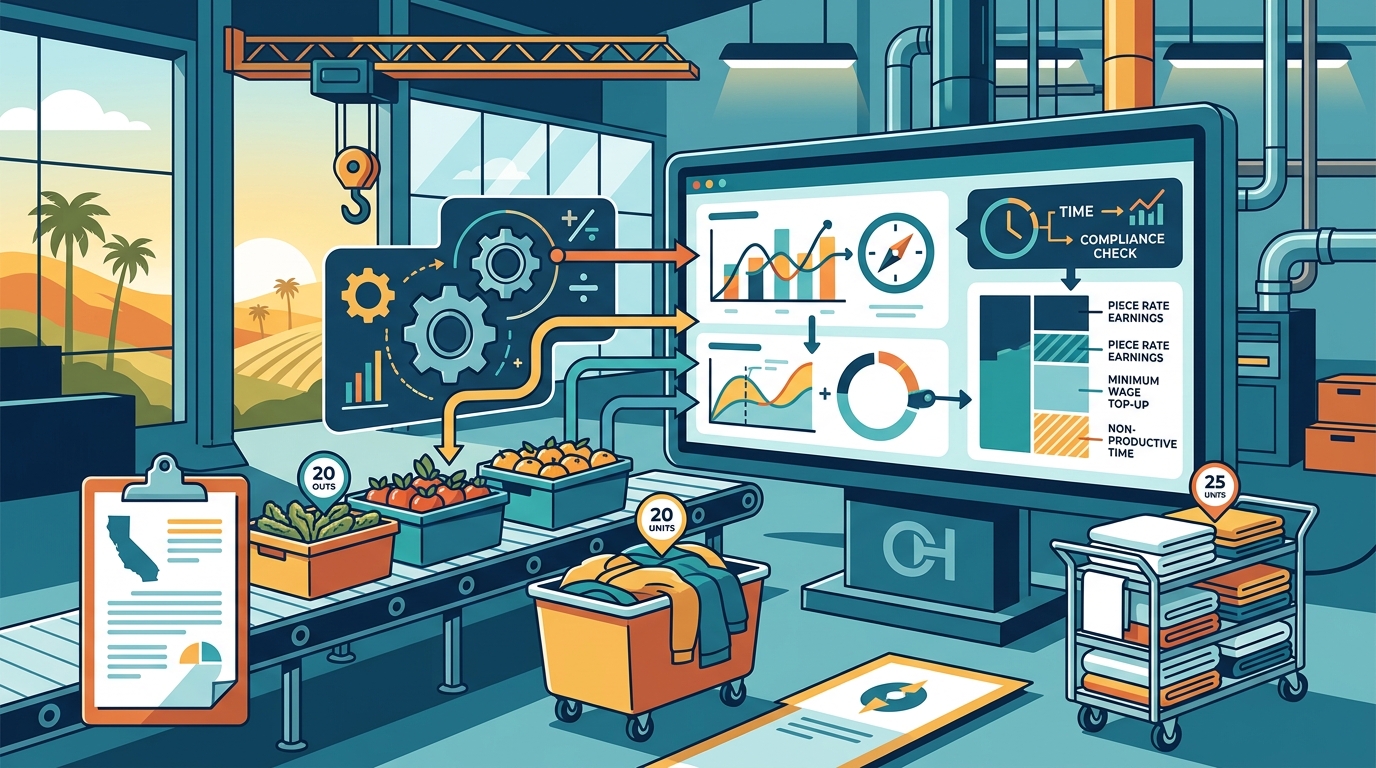
Software Comparison for Piece-Rate
Not all HCM platforms are created equal when it comes to piece-rate pay. Below is a comparison of key capabilities relevant to California employers.
| Feature | ONEHCM | Generic Payroll Software | Standalone Time Clocks |
|---|---|---|---|
| Piece-Rate Pay Support | Native Integration | Limited or Manual | None |
| Weighted Average Calculation | Automated | Manual Calculation | Not Applicable |
| Non-Productive Time Tracking | Integrated | Disjointed | Basic Only |
| California Wage Order Compliance | Built-In | Requires Updates | None |
| Unified Employee Record | Yes | No | No |
As noted in recent industry analyses, unified platforms significantly reduce compliance risks by eliminating data silos. The ONEHCM blog provides further insights into these compliance strategies.
Key Takeaways
- Piece-rate workers in California are entitled to minimum wage for all hours, including non-productive time.
- Employers must calculate a weighted average hourly rate for overtime and premium pay.
- Manual calculations are prone to error and should be avoided.
- ONEHCM offers native piece-rate pay support with automated compliance calculations.
- Integrated timekeeping and payroll are essential for accurate reporting.
- Real-time data visibility helps manage labor costs effectively.
- Unified HCM platforms reduce the risk of wage and hour violations.
Frequently Asked Questions
Does California require piece-rate workers to be paid for breaks?
Yes. California law requires that piece-rate workers be paid at least minimum wage for all non-productive time, including rest breaks and mandatory meetings. This time must be tracked separately from piece-rate work.
How is overtime calculated for piece-rate employees?
Overtime is calculated using a weighted average hourly rate. This rate is determined by dividing total piece-rate earnings by total hours worked, including non-productive time. The overtime premium is then applied to this average rate.
Can ONEHCM handle multiple piece rates for one employee?
Yes. ONEHCM allows employers to assign different piece rates to different tasks or units for the same employee. The system automatically calculates the weighted average for compliance purposes.
What happens if I use a standalone time clock for piece-rate pay?
Standalone time clocks often lack the integration needed to calculate weighted averages automatically. This can lead to manual errors and compliance risks. ONEHCM integrates timekeeping directly with payroll to prevent this.
Is ONEHCM compliant with California wage orders?
ONEHCM is designed to support California wage orders, including those specific to piece-rate pay. The platform automates many of the complex calculations required for compliance.
How does ONEHCM track non-productive time?
Employees can log non-productive time, such as breaks or meetings, directly in the ONEHCM timekeeping module. This data is then used to calculate the weighted average hourly rate.
Does ONEHCM offer reporting for piece-rate labor costs?
Yes. ONEHCM provides robust reporting tools that allow employers to track labor costs per unit and monitor overall profitability in real-time.
Next Steps for Compliance
Ensuring compliance with California piece-rate pay laws requires more than just accurate calculations. It demands a unified system that integrates timekeeping, payroll, and HR management. ONEHCM provides the tools and support necessary to navigate these complexities with confidence.
Ready to streamline your piece-rate payroll and ensure compliance? Request a demo today to see how ONEHCM can transform your workforce management.