

Common Payroll and Time Tracking Mistakes California Small Businesses Make
California labor laws are widely recognized as the most stringent in the United States, creating a complex compliance landscape for small business owners. Recent data indicates that over 60% of small businesses face at least one significant payroll violation annually due to unfamiliarity with these regulations. This high error rate often stems from relying on outdated spreadsheets or generic software that lacks state-specific logic. Understanding these pitfalls is essential for protecting your company from costly audits and employee disputes. (Contact Us OnePoint HCM)
Overtime Calculation Errors
One of the most frequent and expensive mistakes involves overtime pay. In California, non-exempt employees are entitled to one and a half times their regular rate of pay for any hours worked over eight in a single workday. This rule applies regardless of the standard workweek. Many small business owners mistakenly believe that overtime only triggers after 40 hours in a week, which is a federal standard that does not override state law. (ONEHCM Human Connection Management)
Another critical error occurs with double-time pay. Employees must receive double their regular rate for any hours worked beyond 12 in a single workday or for the first eight hours on the seventh consecutive day of work. Failing to track daily hours accurately makes it nearly impossible to calculate these premiums correctly. This is where a unified time tracking system becomes indispensable for maintaining compliance.
Meal and Rest Break Violations
California mandates specific meal and rest breaks that are strictly enforced. Employees are entitled to a 30-minute unpaid meal break for every five hours worked. If the workday extends beyond six hours, a second meal break is required. Furthermore, employees must receive a 10-minute paid rest break for every four hours worked or major fraction thereof.
Small businesses often fail to ensure that employees actually take these breaks or that they are relieved of all duties during meal periods. The concept of "on-duty" meal periods is rare and requires specific written agreements. Ignoring these requirements can lead to significant penalty wages. Proper scheduling tools help managers monitor break compliance in real time.
Paid Time Off and Sick Leave
California requires employers to provide paid sick leave to all employees. This accrual begins on the date of hire, and employees can use it after 90 days of employment. The law mandates that employees accrue at least one hour of paid sick leave for every 30 hours worked. Small businesses often overlook this accrual process, leading to underpayment of wages.
Additionally, some local jurisdictions in California have their own paid sick leave ordinances that may exceed state requirements. For example, San Francisco and Los Angeles have specific accrual rates and usage rules. Keeping track of these varying local laws is challenging without automated benefits administration software that updates dynamically with legislative changes.
Misclassifying Independent Contractors
The classification of workers is a major area of scrutiny for the California Labor Commissioner. The implementation of Assembly Bill 5 (AB5) and the Dynamex decision established the "ABC test" for determining whether a worker is an employee or an independent contractor. Under this test, a worker is presumed to be an employee unless the hiring entity can prove they are free from control, perform work outside the usual course of the business, and are customarily engaged in an independent trade.
Many small businesses incorrectly classify workers as contractors to save on taxes and benefits. This mistake can result in back taxes, penalties, and interest. Correct classification is vital for maintaining a compliant workforce. Understanding the nuances of human resources compliance is the first step in avoiding this pitfall.
Inadequate Record Keeping
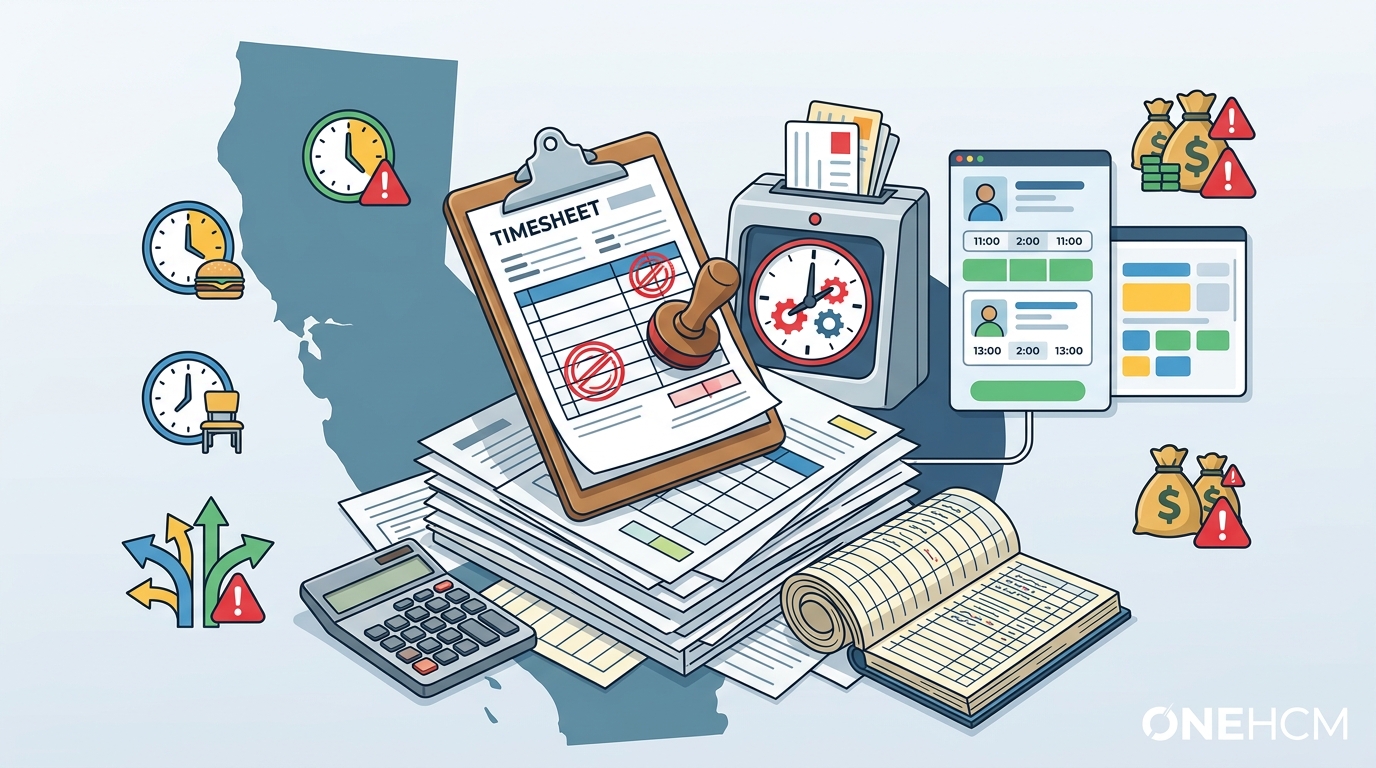
California law requires employers to keep accurate records of employee wages, hours worked, and deductions for at least four years. These records must include the employee's name, social security number, address, and rate of pay. Small businesses often rely on informal methods like paper timesheets or disjointed spreadsheets that are prone to loss or error.
Failing to maintain these records can lead to severe penalties during an audit. If an employer cannot produce accurate records, the employee's testimony may be accepted as fact. A centralized payroll system ensures that all data is stored securely and is easily retrievable when needed.
Choosing the Right HCM System
To avoid these common mistakes, small businesses need a robust Human Capital Management (HCM) platform designed for California's regulatory environment. Generic payroll software often lacks the specific logic required for state compliance. ONEHCM offers a unified solution that integrates HR, payroll, and time tracking into a single platform.
By consolidating these functions, businesses can eliminate data silos and reduce the risk of manual entry errors. The platform provides real-time data and automation to help HR teams save time and enhance compliance. For more information on how ONEHCM can support your business, visit our service commitment page.
| Mistake Category | California Requirement | ONEHCM Solution |
|---|---|---|
| Overtime Calculation | 1.5x after 8 hours/day, 2x after 12 hours/day | Automated Timekeeping |
| Meal Breaks | 30 min unpaid after 5 hours | Break Tracking |
| Sick Leave | 1 hour per 30 hours worked | Accrual Management |
| Record Keeping | 4 years of wage/hour data | Secure Reporting |
Key Takeaways
- California overtime rules trigger after 8 hours in a day, not just 40 in a week.
- Double-time pay is required for hours worked beyond 12 in a single workday.
- Meal breaks must be unpaid and employees must be relieved of all duties.
- Paid sick leave accrues at one hour per 30 hours worked starting from hire date.
- The ABC test under AB5 makes classifying workers as independent contractors difficult.
- Employers must keep wage and hour records for at least four years.
- Unified HCM platforms like ONEHCM reduce compliance risks through automation.
Frequently Asked Questions
What is the penalty for missed meal breaks in California?
Employers must pay one hour of premium pay at the regular rate of pay for each workday that a meal or rest break is not provided. This is known as a "meal and rest period premium."
How does California define overtime for non-exempt employees?
Overtime is calculated based on daily hours worked. Non-exempt employees earn 1.5 times their regular rate for hours over 8 in a day and 2 times for hours over 12 in a day.
Can small businesses in California use spreadsheets for payroll?
While not illegal, spreadsheets are prone to error and do not automate compliance updates. Using a dedicated payroll solution is recommended to ensure accuracy and legal adherence.
What is the ABC test for independent contractors?
The ABC test presumes a worker is an employee unless the employer proves they are free from control, perform work outside the usual course of the business, and are customarily engaged in an independent trade.
How long must California employers keep payroll records?
Employers must maintain accurate records of employee wages, hours worked, and deductions for at least four years.
Does ONEHCM support California labor law compliance?
Yes, ONEHCM is designed to handle complex state-specific regulations including overtime, sick leave accruals, and break tracking.
What is Human Connection Management?
Human Connection Management is ONEHCM's philosophy of combining technology with personalized service to help businesses connect with their employees effectively.
Ready to Streamline Your Payroll?
Stop worrying about compliance errors and start focusing on growing your business. ONEHCM provides the tools and support you need to manage your workforce efficiently. Request a demo today to see how our platform can transform your HR processes.