

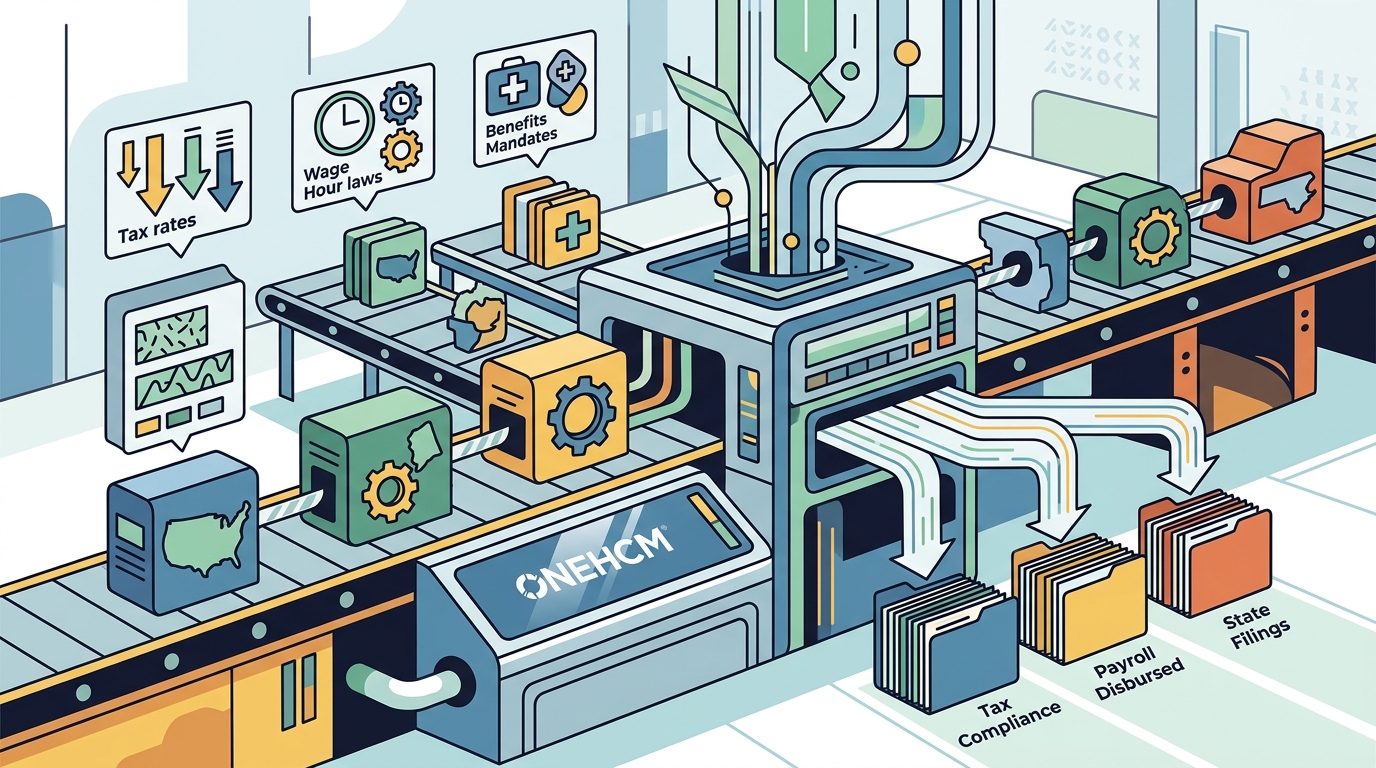
Managing payroll for a distributed workforce is no longer a simple calculation exercise. It is a high-stakes regulatory minefield. According to recent industry data, over 60% of mid-sized companies now employ workers across multiple state jurisdictions, creating a compliance burden that manual spreadsheets cannot survive. When you add varying local tax rates, distinct wage hour laws, and unique benefit mandates, the risk of costly penalties skyrockets. This guide explains how modern Human Capital Management (HCM) platforms resolve these friction points. (Contact Us OnePoint HCM)
Understanding Multi-State Payroll Complexity
Payroll complexity arises from the fragmentation of state and local tax codes. Each jurisdiction operates with independent rules regarding income tax withholding, unemployment insurance, and mandatory benefits. Multi-state payroll complexity is defined as the operational challenge of accurately calculating, reporting, and remitting taxes across multiple distinct legal jurisdictions simultaneously.
Consider the scenario of a remote worker who lives in one state but works for a company headquartered in another. The employer must navigate the nexus laws of both regions. If the worker travels to a third state for a conference, temporary work rules may trigger additional tax liabilities. Without automated software, HR teams spend hundreds of hours manually adjusting spreadsheets. This manual approach is prone to human error, which leads to underpayments, overpayments, and severe compliance violations.
The landscape of American payroll changed significantly with recent legislative updates. For instance, the implementation of the One Big Beautiful Bill Act introduced new tax structures that affect overtime and tip reporting. These federal shifts interact dynamically with state-level regulations, requiring software that updates in real-time to maintain accuracy.
Core Features for Jurisdictional Compliance
To handle multi-state payroll effectively, software must go beyond basic tax calculations. It requires a robust engine that automatically detects the employee's work location and applies the correct tax tables. Here are the critical features required for compliance.
Automated Tax Filing and Remittance
Manual filing is a relic of the past. Modern systems automatically calculate the exact tax liability for every state, county, and city where an employee works. The software then generates the necessary forms and submits them to the appropriate agencies. This automation ensures that deadlines are never missed, regardless of how many states are involved. According to compliance experts, automated filing reduces penalty risks by over 90% compared to manual processes.
Dynamic Nexus Tracking
Nexus refers to the connection between a business and a state that triggers tax obligations. This connection can be physical, economic, or digital. Nexus tracking is the continuous monitoring of employee locations to determine when a new tax obligation is triggered. For example, if a salesperson works from home in a new state for more than 30 days, the company may need to register for income tax withholding in that state immediately.
Unified Employee Records
A single source of truth is essential for accuracy. When an employee moves or changes their work arrangement, the system must update their profile instantly. This update should cascade through all modules, including benefits, time tracking, and payroll. A fragmented system where HR data lives in one place and payroll data in another creates dangerous discrepancies.
The Power of Unified HCM Systems
Specialized payroll software is good, but an integrated Human Capital Management (HCM) platform is superior for multi-state operations. Integration eliminates data silos and ensures that every decision is based on current, accurate information.
Seamless Data Flow
In a unified system, data flows seamlessly from recruitment to retirement. When a new hire is onboarded, their state of residence is captured immediately. This data feeds directly into the payroll engine, ensuring that tax withholdings are correct from the first paycheck. There is no need for manual data entry or file uploads, which are common sources of error.
Real-Time Compliance Updates
Regulations change frequently. A unified platform like ONEHCM provides real-time data updates to ensure that your payroll runs are always compliant. This includes updates to minimum wage laws, paid leave requirements, and tax rates. By consolidating these tools into one cloud-based platform, organizations can save time and minimize errors significantly.
One client in the financial services industry reported eliminating over 3,000 reports and saving 500 hours after implementing a unified solution. This efficiency gain allows HR teams to focus on strategic initiatives rather than administrative firefighting. The ability to track an employee from recruitment to retirement using one record simplifies the entire employee lifecycle.
Industry-Specific Payroll Challenges
Different industries face unique multi-state payroll challenges. Understanding these nuances is crucial for selecting the right software.
Construction and Manufacturing
Construction companies often deal with prevailing wage laws and certified payroll requirements. These rules mandate that contractors on government-funded projects pay workers region-specific rates. Prevailing wage laws require detailed weekly reporting to prove compliance. Manufacturing firms may also face complex piece-rate pay calculations that vary by location.
Healthcare and Non-Profit
Healthcare organizations often have unionized workforces with complex collective bargaining agreements. These agreements may include shift differentials and overtime rules that vary by state. Non-profit organizations must also navigate specific tax-exempt status requirements that affect how payroll taxes are handled. Accurate benefits administration is critical in these sectors to ensure that contributions match state mandates.
Retail and Brokers
Retail businesses with multiple locations must manage payroll for employees who work across different jurisdictions. This includes handling local minimum wage differences and paid sick leave mandates. Brokerage firms often have independent contractors who require specific 1099 processing capabilities that comply with state-level contractor classification laws.
Platform Capabilities Comparison
When evaluating multi-state payroll solutions, it is important to compare capabilities across key dimensions. The table below outlines how integrated HCM platforms differ from traditional standalone payroll systems.
| Feature | Standalone Payroll Software | Integrated HCM Platform |
|---|---|---|
| Tax Filing | Manual or semi-automated | Fully automated with real-time updates |
| Data Silos | High risk of fragmentation | Unified employee record |
| Compliance Updates | Delayed or manual patching | Instant automatic synchronization |
| Reporting | Limited to payroll data | Cross-functional analytics |
| Support | Generic customer service | Dedicated partnership and consulting |
As shown in the comparison, integrated platforms offer significant advantages in terms of data integrity and compliance speed. The ability to share information seamlessly between modules is a game-changer for multi-state operations.
Key Takeaways
- Multi-state payroll complexity involves navigating varying tax codes, wage laws, and benefit mandates across jurisdictions.
- Automated tax filing and remittance reduce penalty risks by over 90% compared to manual processes.
- Nexus tracking is essential for identifying when new tax obligations are triggered by employee location changes.
- Unified HCM systems eliminate data silos by maintaining a single employee record across all modules.
- Construction and manufacturing sectors face unique challenges with prevailing wage and certified payroll reporting.
- Real-time compliance updates ensure that payroll runs remain accurate despite frequent regulatory changes.
- ONEHCM provides dedicated support and a unified solution to help HR teams save time and enhance engagement.
Frequently Asked Questions
How does multi-state payroll software handle tax withholding?
Multi-state payroll software automatically detects the employee's work location and applies the correct tax tables for each jurisdiction. It calculates the exact withholding amount based on current state and local rates, ensuring accurate deductions from every paycheck.
What is nexus in payroll compliance?
Nexus refers to the connection between a business and a state that triggers tax obligations. This can be physical, economic, or digital. Tracking nexus is critical because it determines where the company must register and pay taxes.
Can ONEHCM handle prevailing wage requirements?
Yes, ONEHCM is designed to handle complex payroll scenarios, including prevailing wage and certified payroll requirements for construction and manufacturing clients. The system ensures that region-specific rates are applied correctly.
How does an integrated HCM system improve accuracy?
An integrated HCM system improves accuracy by eliminating manual data entry and data silos. When HR, benefits, and payroll data live in one place, updates are synchronized instantly, reducing the risk of errors.
What happens if an employee moves to a new state?
If an employee moves, the software updates their profile and automatically adjusts tax withholdings and benefit elections. It also triggers any necessary nexus checks to ensure the company remains compliant in the new jurisdiction.
Does ONEHCM offer support for ACA compliance?
Yes, ONEHCM includes robust ACA Manager tools to help organizations navigate Affordable Care Act requirements. This includes tracking full-time equivalents and managing enrollment processes across different states.
How does ONEHCM reduce reporting burdens?
ONEHCM reduces reporting burdens by automating the generation and submission of tax forms. Clients have reported eliminating thousands of reports and saving hundreds of hours by switching to a unified platform.
Is ONEHCM suitable for small businesses?
Yes, ONEHCM is designed to scale with your business. It offers personalized support and flexible solutions that cater to the needs of small businesses as well as large enterprises.
Next Steps for Your Organization
Managing multi-state payroll does not have to be a source of stress. By choosing an integrated HCM platform, you can streamline your workforce operations, ensure compliance, and focus on what matters most: your people. ONEHCM provides the tools and support you need to navigate this complexity with confidence.
Ready to transform your payroll process? Request a demo today to see how ONEHCM can help your organization achieve measurable impact. Visit our Why OneHCM page to learn more about our service commitment. For more insights on HR compliance, explore our blog.