

Managing Prevailing Wage Compliance in California and Across Multiple States
Prevailing wage laws require contractors on government-funded projects to pay workers region-specific rates, while certified payroll is the weekly reporting that proves compliance. For construction and manufacturing leaders, navigating these regulations is not merely an administrative task but a critical operational necessity. The landscape of American payroll changed overnight with recent legislative updates, yet the core challenge remains: ensuring accurate wage calculations and timely reporting across diverse geographic jurisdictions. Organizations that fail to adapt risk severe penalties, project delays, and reputational damage. This guide outlines the strategic approach to mastering prevailing wage compliance, leveraging unified technology to streamline the process. (Contact Us OnePoint HCM)
Understanding Prevailing Wage and Certified Payroll
Prevailing wage is the standard hourly rate paid to the majority of workers in a specific trade within a particular locality. This rate is typically determined by government agencies and includes both the base wage and fringe benefits. Certified payroll is the formal documentation submitted to the contracting agency to prove that workers were paid at least the prevailing wage rate. These two concepts are inextricably linked; without accurate certified payroll, prevailing wage compliance is impossible to verify.
The complexity arises because prevailing wage rates vary significantly by county, city, and even project type. What constitutes a compliant rate in one jurisdiction may be entirely non-compliant in another. For contractors operating across state lines, this variability creates a fragmented data environment. Manual tracking methods, such as spreadsheets, often fail to capture these nuances in real time. This leads to errors in wage calculations, missed fringe benefit contributions, and ultimately, non-compliance.
According to recent industry analyses, the cost of non-compliance can exceed the profit margin of the project itself. Penalties often include back wages, interest, and administrative fines. Therefore, understanding the foundational definitions is the first step toward mitigation. Prevailing wage is not a suggestion; it is a legal mandate enforced through rigorous reporting mechanisms.
California Prevailing Wage Requirements
California has some of the most stringent prevailing wage laws in the nation. The state Department of Industrial Relations (DIR) oversees these regulations, requiring contractors to pay workers the locally prevailing wage for all public works projects. This includes not only the hourly rate but also the value of fringe benefits provided.
One critical aspect of California compliance is the requirement for daily overtime calculations. Unlike federal Davis-Bacon Act rules, which typically calculate overtime on a weekly basis, California law often requires daily overtime for hours worked over eight in a day. This distinction is vital for payroll accuracy and can significantly impact labor costs. Contractors must ensure their timekeeping systems capture daily hours with precision.
Additionally, California requires the submission of certified payroll records weekly. These records must detail the name of each worker, their classification, hours worked, and gross wages paid. Any discrepancy between the reported hours and the actual work performed can trigger an audit. Recent legislative updates have further tightened enforcement, making real-time data integration essential for compliance.
For businesses operating in California, the risk of non-compliance is heightened by the state's aggressive audit practices. The DIR regularly reviews payroll records to ensure adherence to prevailing wage laws. Failure to comply can result in debarment from future public works projects, a severe consequence for any construction firm.
Challenges of Multi-State Compliance
Operating across multiple states introduces a layer of complexity that multiplies the challenges of single-state compliance. Each state has its own prevailing wage laws, definitions, and reporting requirements. For example, while California focuses on daily overtime, other states may adhere to weekly calculations. Some states require pre-award prevailing wage determinations, while others rely on post-award submissions.
The fragmentation of data is a primary obstacle. When payroll data is siloed in disparate systems, it becomes difficult to maintain a unified view of compliance status. This fragmentation leads to inconsistencies in reporting and increases the likelihood of errors. Contractors must navigate varying definitions of "bona fide fringe benefits" and different methods for calculating overtime.
Another significant challenge is the timeliness of data. Prevailing wage compliance requires weekly or daily submissions, depending on the jurisdiction. Manual processes cannot keep pace with these demands, especially when managing multiple projects simultaneously. The lag in data processing often results in late submissions, which can trigger penalties and audits.
Furthermore, the interpretation of prevailing wage rates can vary by local authority. What one county considers a valid classification may differ from a neighboring county. This variability requires contractors to stay constantly updated on local regulations, a task that is increasingly difficult without automated support.
The Role of Unified HCM Technology
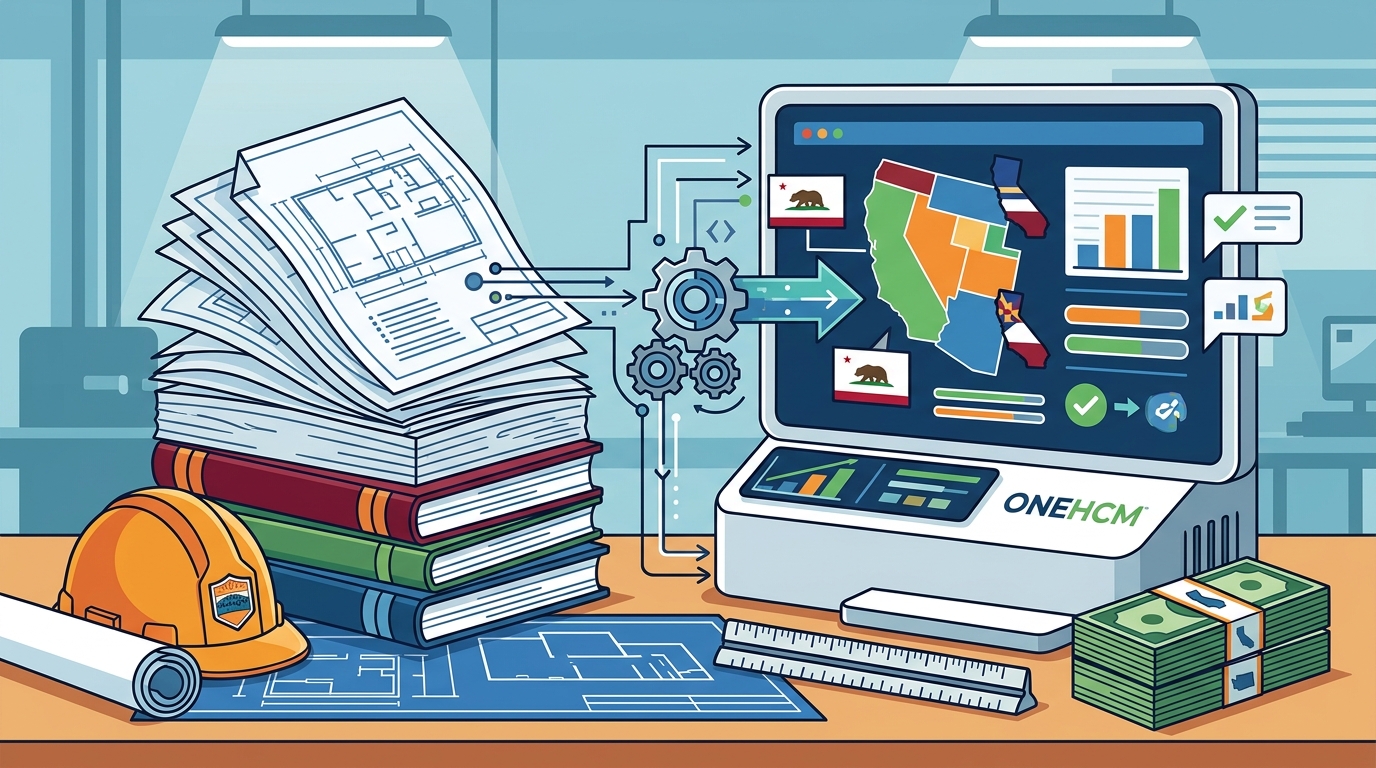
Unified Human Capital Management (HCM) technology offers a strategic solution to the complexities of prevailing wage compliance. By consolidating HR, payroll, time and labor, and benefits administration into a single platform, organizations can streamline their compliance workflows. ONEHCM provides such a unified solution, enabling contractors to manage prevailing wage requirements efficiently.
A unified platform eliminates data silos by creating a single source of truth for all workforce data. This integration ensures that timekeeping data flows seamlessly into payroll calculations, reducing the risk of manual entry errors. Real-time data access allows for immediate identification of compliance issues, enabling proactive correction before submissions are made.
Automation is another key benefit of unified HCM technology. Automated workflows can handle the generation of certified payroll records, ensuring that all required fields are populated correctly and submitted on time. This automation reduces the administrative burden on HR and payroll teams, allowing them to focus on strategic initiatives rather than repetitive data entry.
Moreover, unified platforms often include compliance management tools that track regulatory changes across jurisdictions. These tools can alert users to new prevailing wage rates or updated reporting requirements, ensuring that the organization remains compliant with minimal effort. By leveraging such technology, contractors can transform compliance from a reactive burden into a proactive advantage.
Building a Robust Compliance Workflow
Establishing a robust compliance workflow is essential for managing prevailing wage requirements effectively. The first step is to implement accurate timekeeping practices that capture all hours worked, including overtime and fringe benefit contributions. This data must be collected in real time to ensure accuracy.
Next, organizations should integrate their timekeeping system with their payroll platform. This integration ensures that wage calculations are based on the most current data, reducing the risk of discrepancies. Automated payroll processing can then generate certified payroll records that meet the specific requirements of each jurisdiction.
Regular audits are also critical to maintaining compliance. Internal audits can identify potential issues before they become problems, allowing for timely correction. These audits should review timekeeping records, payroll calculations, and certified payroll submissions for accuracy and completeness.
Finally, ongoing training for HR and payroll staff is necessary to keep them informed about regulatory changes. Compliance is not a one-time effort but a continuous process that requires vigilance and adaptability. By building a culture of compliance, organizations can mitigate risk and ensure long-term success in government contracting.
Key Takeaways
- Prevailing wage laws mandate region-specific pay rates for government-funded projects, requiring strict adherence to local regulations.
- California enforces daily overtime calculations, which differ from federal weekly standards and impact labor costs significantly.
- Certified payroll records must be submitted weekly in California, detailing worker classifications, hours, and wages.
- Multi-state compliance is complicated by varying definitions of fringe benefits and overtime rules across jurisdictions.
- Unified HCM technology consolidates HR, payroll, and timekeeping data, reducing errors and improving compliance efficiency.
- Automation in payroll processing ensures timely and accurate submission of certified payroll records.
- Regular internal audits and staff training are essential for maintaining ongoing compliance and mitigating risk.
Frequently Asked Questions
What is the difference between prevailing wage and minimum wage?
Prevailing wage is the locally determined standard rate for specific trades in public works projects, which is often higher than the state or federal minimum wage. Minimum wage is the baseline legal pay rate for all workers, regardless of the project type.
How often must certified payroll be submitted in California?
In California, certified payroll records must be submitted weekly for all public works projects. These records must detail the hours worked, wages paid, and fringe benefits provided for each worker.
Can I use spreadsheets for prevailing wage compliance?
While spreadsheets can be used, they are prone to errors and lack the automation needed for timely submissions. Unified HCM platforms offer automated workflows that reduce the risk of non-compliance.
What happens if I fail to comply with prevailing wage laws?
Non-compliance can result in penalties, back wage payments, interest, and debarment from future public works projects. The financial and reputational damage can be severe.
How does ONEHCM help with prevailing wage compliance?
ONEHCM provides a unified platform that integrates timekeeping, payroll, and benefits administration. This integration ensures accurate wage calculations and automated generation of certified payroll records, streamlining compliance across multiple jurisdictions.
Are prevailing wage rates the same across all counties in California?
No, prevailing wage rates vary by county and even by city in California. Contractors must consult the local Department of Industrial Relations determinations for each project location.
What is the role of fringe benefits in prevailing wage?
Fringe benefits are part of the prevailing wage rate. Contractors must either pay the benefit amount directly to workers or contribute to a bona fide fringe benefit fund on their behalf.
Streamline Your Prevailing Wage Compliance Today
Managing prevailing wage compliance across California and multiple states requires precision, speed, and unified data. ONEHCM offers the integrated solution you need to eliminate errors and ensure adherence to complex regulations. By consolidating your HR, payroll, and timekeeping into one platform, you can focus on growing your business while we handle the compliance complexity. Request a Demo today to see how ONEHCM can transform your workforce management.